Holy Trinity Column in Olomouc
Also known as Sloup Nejsvětější Trojice v Olomouci, Holy Trinity Column, Olomouc
A Baroque column of stone saints and gilded copper, made entirely by Olomouc craftsmen.
01
Introduction
A column of saints that took 37 years, a string of stonemasons and one impatient council
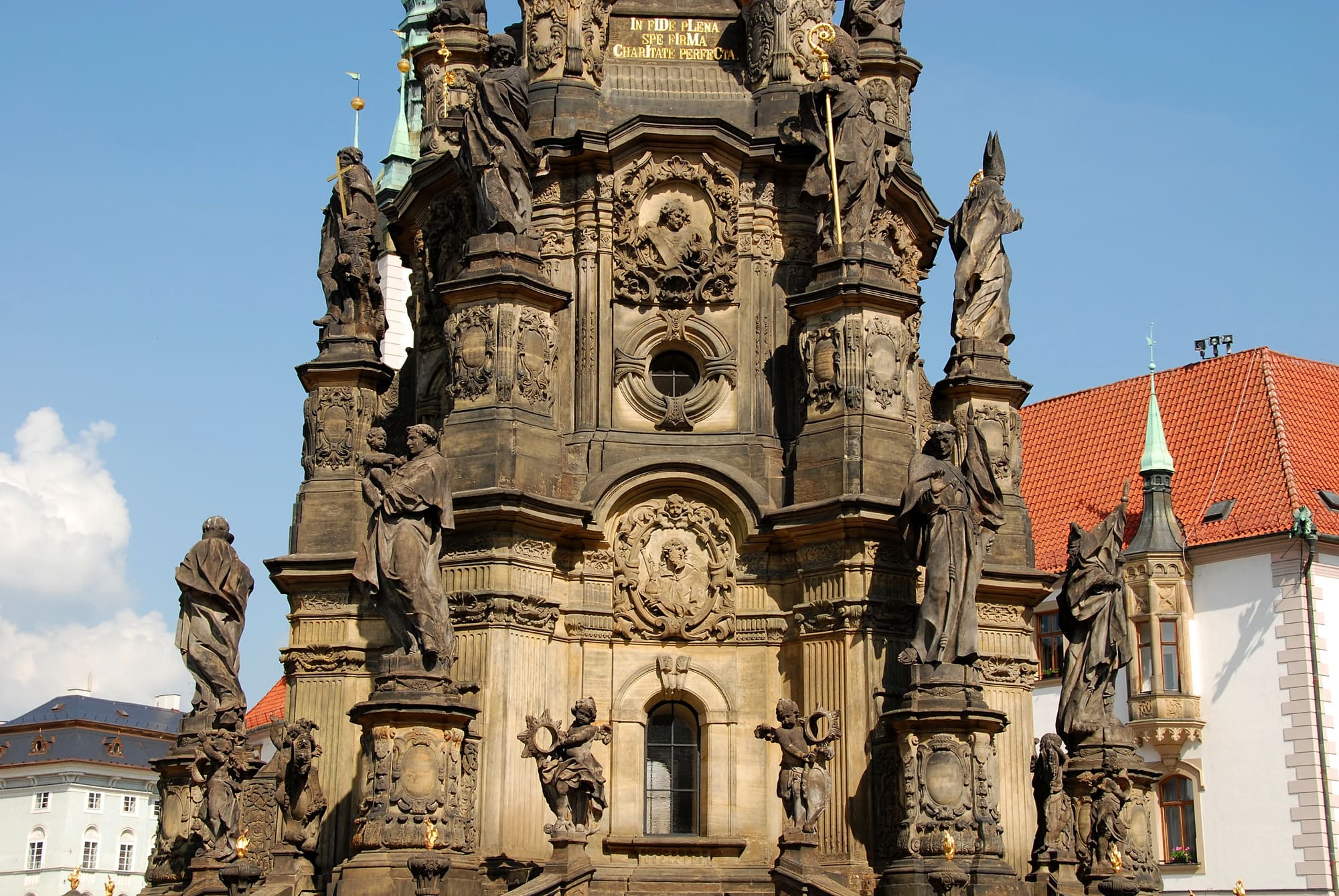
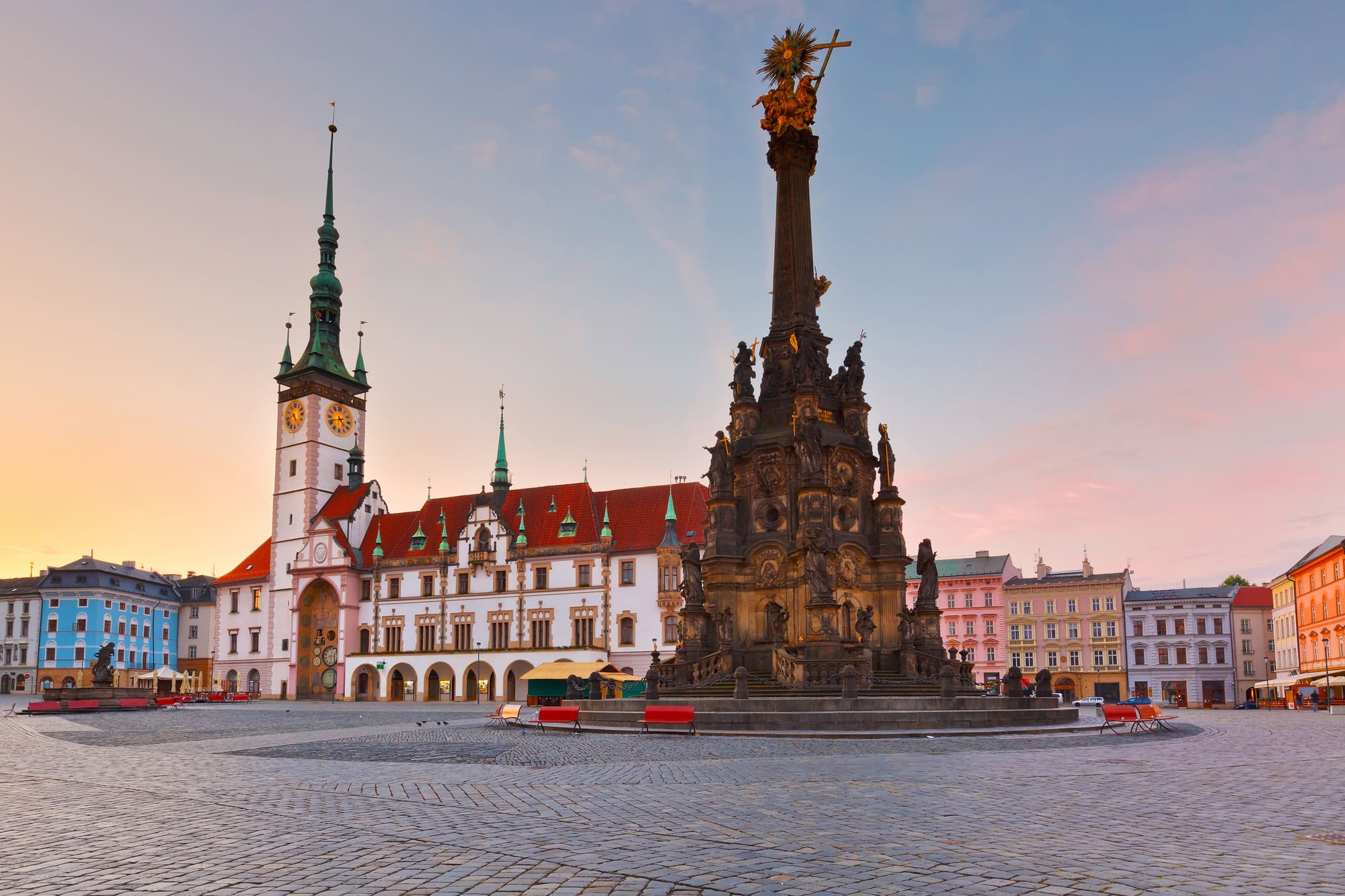
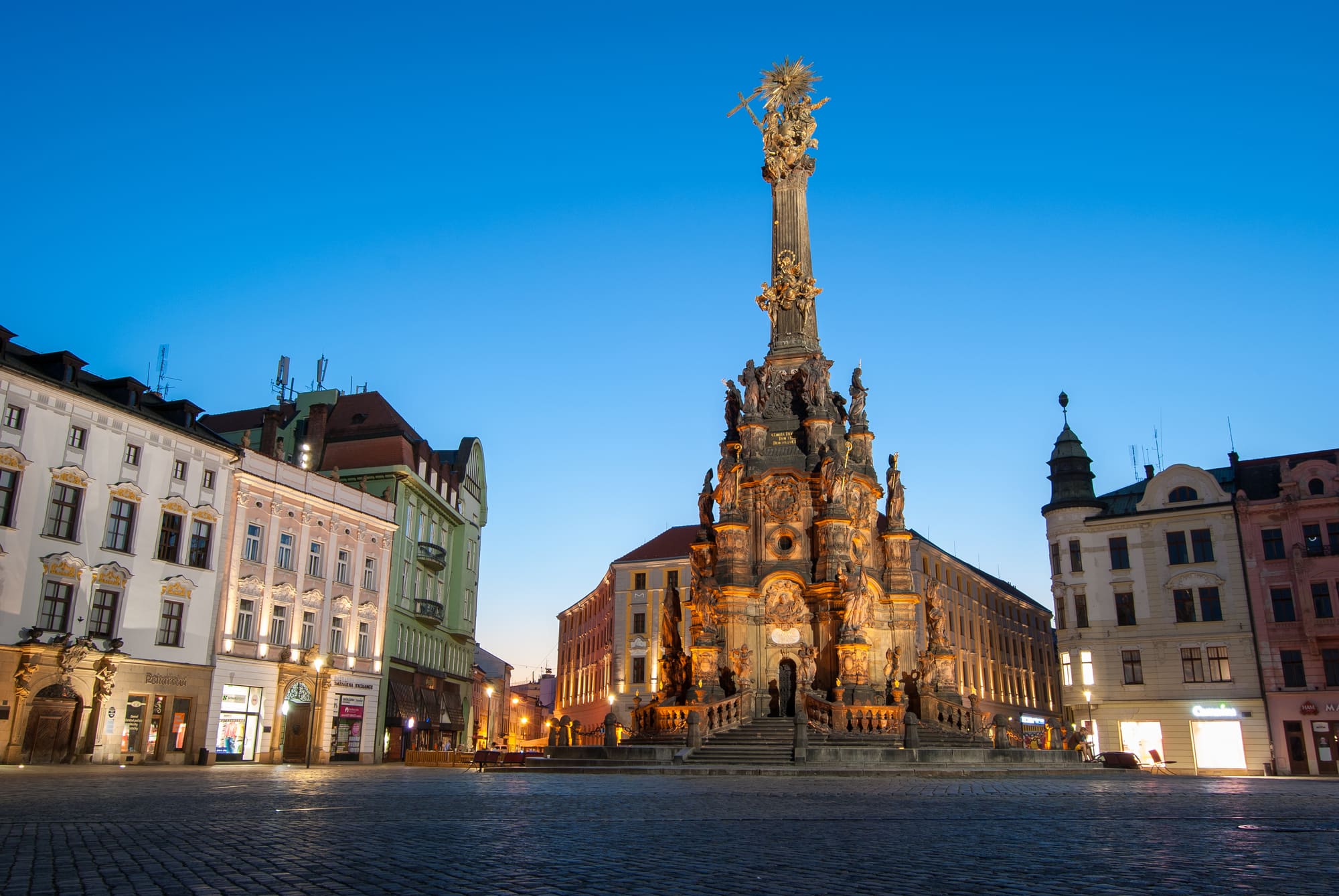
The Holy Trinity Column in Olomouc rises about 32 metres from the Upper Square (Horní náměstí) of a university city in eastern Czechia, and almost every surface of it is carved, gilded or both. Calling it a column undersells it. Eighteen stone saints stand around it in tiers, with twelve light-bearers and twelve relief busts of the apostles between them. At the top sit two gilded copper groups: the Assumption of the Virgin Mary, and above her the Holy Trinity.
This is Baroque, the theatrical, church-backed style that dominated Central Europe in the 17th and 18th centuries, and the column took 37 years to build. A stonemason started it in 1717 and died long before it was done, and it was consecrated in 1754 in front of the imperial couple. What really sets it apart is who made it. Every craftsman and artist involved came from Olomouc, a fact the town has been quietly pleased about for more than two and a half centuries.
It is also a working part of the place. The column was inscribed on the World Heritage List, the register of places judged to matter to everyone, in 2000. It then spent more than two years wrapped in scaffolding for a long restoration, and the frame finally came down on 1 September 2026.
02
History
A stonemason's letter to the council, a long wait for the sculptors and a siege four years after the opening
Monuments like this one spread across Catholic Europe after the Council of Trent, the Church's great reform council, and the model for most of them stood in Rome: a column raised in 1614 in the Piazza Santa Maria Maggiore. By the time Olomouc got round to building its own, the fashion was nearly over. The city's own account counts the Holy Trinity Column among the last examples of the wave.
The man behind it was Václav Render, baptised in Olomouc on 31 August 1669. He trained under a local master, gained experience in Kroměříž and then worked as a journeyman in Breslau (now Wrocław), before coming home in 1694 to become a citizen and master stonemason. His workshop grew into one of the largest in Moravia, and an imperial privilege allowed him to build to his own designs anywhere in the Habsburg monarchy. In 1715, with the local plague epidemic still fading, he was busy with the Marian column on the Lower Square and could not stop thinking about a bigger one on the Upper. In early 1716 he wrote to the city council. The councillors approved, Render supplied a model and a budget of about 11,000 guilders, and he paid for the first stages himself.
Building began in 1717. The Hercules Fountain was in the way and had to be moved a little further off. Render did not live to see the result. He died in 1733, aged 64, single and childless, and is buried in the Church of St Maurice. By then he had raised the column to the height of the first storey, which meant the chapel and part of the sculpture, and his estate paid for more of the work. An unfinished stone monument in the middle of town drew a good deal of irritation, and in 1744 the councillors resolved to finish it. Four more stonemasons took it forward in turn, while the sculptural decoration was begun by Filip Sattler and carried on by Ondřej Zahner.
In 1753, as the work neared its end, an Olomouc painter named Ludvík Ignác Müller soaked the stone and the statues in hot oil and painted them white to imitate marble. The city's brochure points out that this means the original color of the column was not the one we see today. On 9 September 1754 Cardinal Ferdinand Julius Troyer, Bishop of Olomouc, consecrated it in the presence of Maria Theresa and Francis of Lorraine. A plaque above the chapel door still records the day.
What the column was for depends on who is asked. Radio Prague, drawing on Czech Radio, says it celebrates the Catholic Church and partly thanks heaven for the end of a plague that struck Moravia in 1714 to 1716. The city's own history says it no longer refers to the plague at all and calls it a column of honour, a triumphal monument.
Only four years after the consecration the monument was in danger. In 1758 the Prussian army besieged Olomouc and several cannonballs hit the column. The townspeople sent a procession to the Prussian general, James Keith, to beg him to spare it, and he agreed. A gilded cannonball mounted on the column commemorates the episode.
The column was inscribed on the World Heritage List on 2 December 2000. The last major restoration had lasted almost a year and a half and ended in 2001, and among other work the restorers took down sculptures in poor condition. Several smaller interventions followed, but weather and earlier repairs had left the surface damaged. A new restoration led by the sculptor René Tikal began in spring 2024 and cost about 30 million Czech crowns, most of it covered by a grant.
03
Timeline
From a Roman model to a restored monument, in 12 dates
A column in Rome's Piazza Santa Maria Maggiore becomes the model for Baroque Marian columns
Václav Render writes to the city council proposing a monument on the Upper Square
Construction begins, and the Hercules Fountain is moved to make room
Render dies with the column built only to the height of the first storey
Olomouc's councillors decide to finish the unfinished monument
A local painter treats the stone with hot oil and paints it white
The column is consecrated in the presence of Maria Theresa and Francis of Lorraine
Prussian cannonballs hit the column during the siege, and the city pleads for mercy
Inscribed on the World Heritage List
A major restoration of almost 18 months ends, with damaged sculptures removed
A long restoration begins under the sculptor René Tikal
The scaffolding is removed after more than two years
04
Why visit
Eighteen saints, a town's loyalties and a monument that explains who paid for it and why
The first reason to come is how much there is to look at. Stand at the base and look up: 18 saints in three tiers, 12 light-bearers, 12 relief busts of the apostles, three allegorical reliefs of Faith, Hope and Love, and gilded copper figures at the summit. The city of Olomouc describes it as the largest group of Baroque statues within a single sculpture in Central Europe. Even the stone is chosen with care: the architecture and reliefs are Maletín sandstone, and the statues were carved from a finer sandstone from Mladějov.
The second is that the column explains itself, if you know how to read it. The saints are not a random selection from the calendar. Cyril and Methodius, who brought Christianity to Moravia, are there, along with Saint Wenceslas, a national saint of the Czech lands, and Saint Florian, called on against fire. John Sarkander, a priest from the Olomouc diocese, stands among them too. Each choice says something about what a town in the 1700s worried about and prayed for, and the figures are worth a slow look rather than a quick photograph.
The third is the story of the people behind it. The column was built and carved entirely by craftsmen from Olomouc, from the master stonemasons down to the sculptors and the painter, and the town regards it as a statement of local pride as much as of faith. It took 37 years, outlived its designer and tested the patience of the council.
The fourth is the setting. The column stands in a town that the city describes as the second-largest monument conservation area in Czechia, among Baroque fountains and a Gothic-Renaissance town hall with a socialist-realist astronomical clock. It is one of the last of the great Baroque honour columns, and in Olomouc you can see it among the streets that produced it.
05
The setting
A flat river valley, a long square and a town hall with a clock that is not what it seems
Olomouc lies on the Morava river in the flat, fertile Upper Morava valley, about 200 kilometres from Prague and 61 kilometres from Brno. It has around 105,000 inhabitants, which makes it the sixth-largest city in Czechia. The climate is humid continental: July is the warmest month, averaging about 20°C, and January the coldest, at about −1°C.
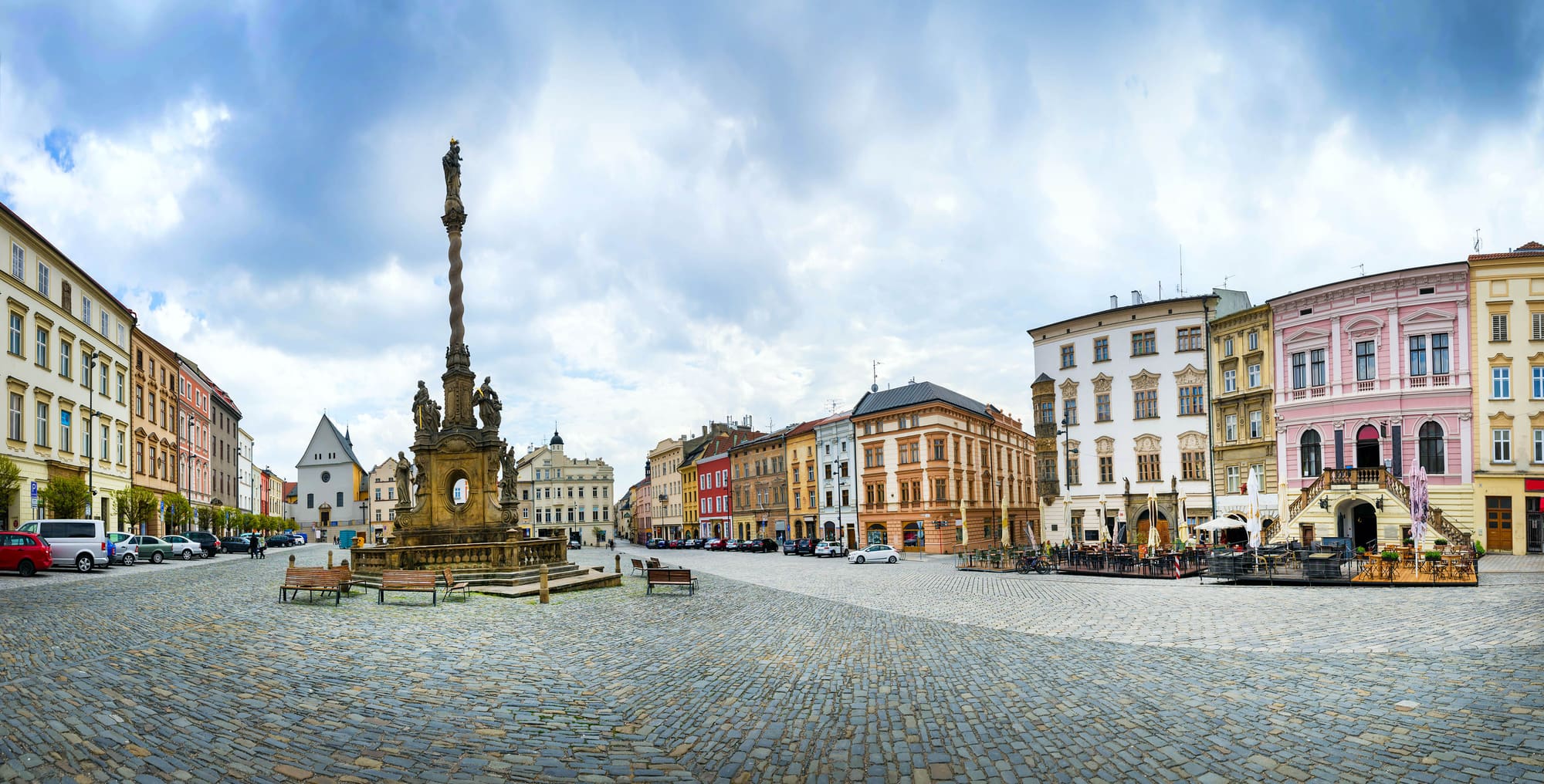
The column stands in the middle of the Upper Square, the larger of the two main squares, and you can walk round it in under a minute. It is the work of one monument in a crowded place. Beside it is the Gothic-Renaissance town hall, first mentioned in 1378, with a tower 76 metres tall and an astronomical clock whose original 15th-century mechanism was remodelled in the style of socialist realism. A few steps away is the Lower Square, where Render's earlier Marian column stands.
The wider historic center is among the most extensive monument conservation areas in the country, and the city's tourist office reckons you can see a good deal of it without long walks. Baroque fountains with names from Roman myth, among them Mercury, Caesar, Neptune, Hercules and Jupiter, are spread across the two squares. The property is tiny by the standards of most World Heritage sites: the column and its surroundings, not a district.
06
Key places
From a chapel too small for its congregation to a clock that performs at noon
The base and the chapel
At the foot of the column is a tiny domed chapel. Services were once held here, and the windows and acoustics were arranged so that a sermon carried across a good part of the Upper Square: the priest stood inside and the congregation listened from outside. Reliefs inside show Old Testament offerings and the Crucifixion. Under one floor tile there is a hole into the Olomouc underground. A plaque above the door records the consecration of 1754. The city says the chapel opens seasonally, and work in that area was unfinished in September 2026, so ask the Information Centre before planning around it.
The saints and apostles
Around the column in three tiers stand 18 stone saints, with 12 small figures the city calls light-bearers, relief busts of the 12 apostles and three reliefs of Faith, Hope and Love. The choices are local and a little stubborn: Cyril and Methodius, Wenceslas, Florian, John Sarkander and Anthony of Padua, one of the Baroque's favorite saints. Binoculars help, because the upper tiers are a long way up and the details blur from the pavement. If you only look at one level, make it the middle one, where the Moravian saints are.
The summit groups
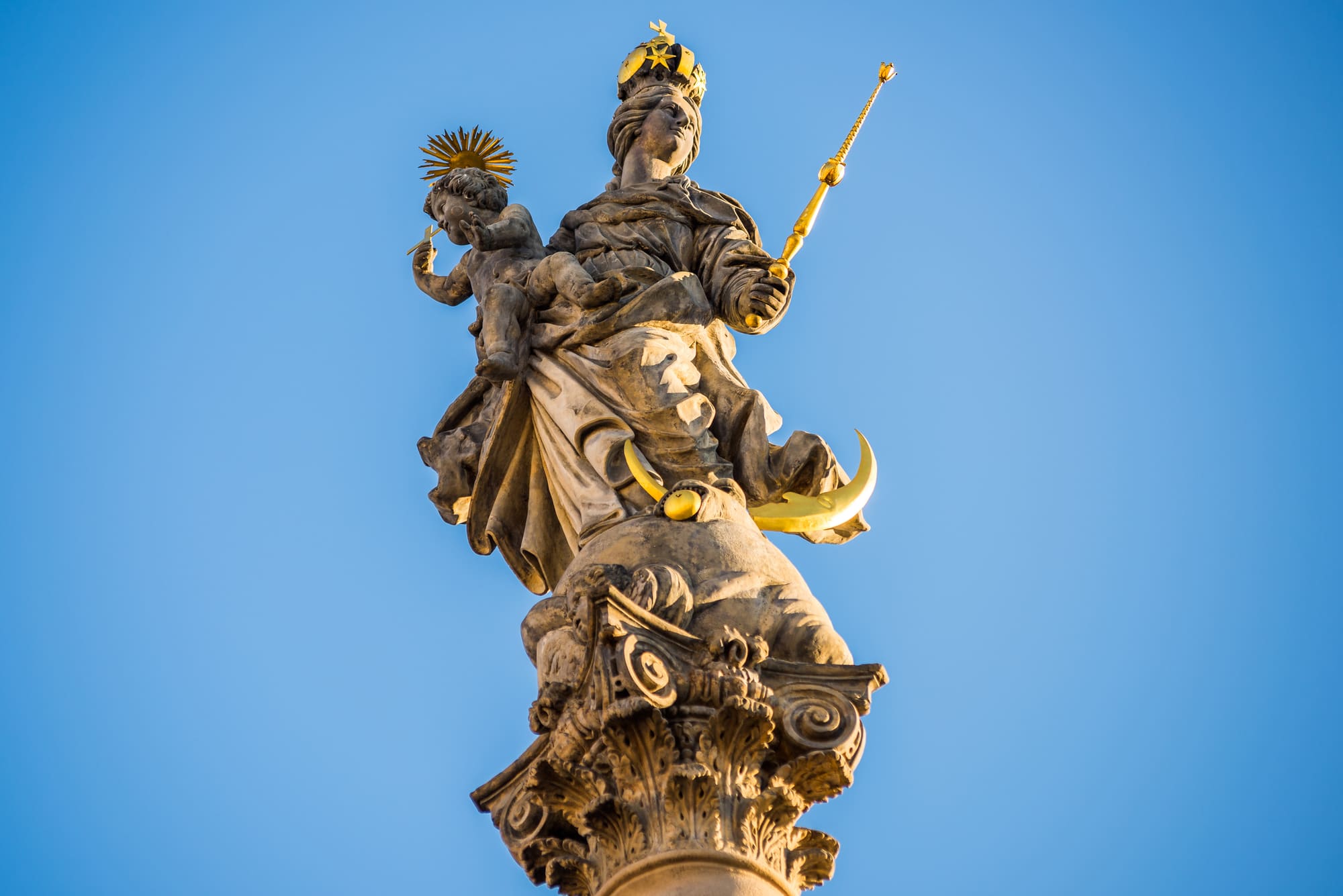
Two gilded copper groups give the column its glint. At the top, a radiant Holy Trinity shows the Father, the Son and the Holy Spirit, accompanied by the Archangel Michael with his flaming sword. Lower down, the Assumption of the Virgin Mary shows her carried to heaven by two angels, which also acts as a dividing line between the heavenly and earthly parts of the design. The architecture is Maletín sandstone and the statues are Mladějov sandstone, so the copper stands out against the stone. The gilding was repaired in the recent restoration.
The Baroque fountains
The column belongs to a set. Mercury, Caesar, Neptune, Hercules and Jupiter fountains stand on the Upper and Lower Squares, and Render himself made several of the city's fountains. The Hercules Fountain was the one that stood in the way of the column and had to be moved a short distance. They are worth a slow lap rather than a quick look, since each is a small Baroque sculpture in its own right. The Information Centre in the town hall arcade can point you to the full set.
The town hall and astronomical clock
On the north wall of the town hall is an astronomical clock about 14 metres high, remodelled in the 1950s in the style of socialist realism, so its figures are workers, a miner and a volleyball player rather than saints. At noon they file past the windows in a performance that lasts about seven minutes. The tower is 76 metres tall and, on selected summer dates, has been open to climb. Check the Olomouc Tourism site for the current dates.
The Marian column on the Lower Square
Render's earlier project stands a few steps away on the Lower Square. It was built after the plague of 1713 to 1715 and carries statues of saints invoked against plague, among them Roch, Sebastian, Rosalia of Lima and Charles Borromeo. The statue of Saint Sebastian was added after the Prussian bombardment of 1758. Comparing it with the Upper Square monument is a quick lesson in how Render's ambitions grew. It is smaller, more conventional and a good deal easier to photograph.
07
What to expect
A neck-craning stop, a fence round the base and a clock you may not have planned to watch
You can't climb the column. What you can do is walk round it, which takes under a minute, and then spend a good deal longer looking up. At about 32 metres the top groups are hard to read from the pavement, and the gilded Trinity is more of a glint than a picture. Binoculars or a camera with a zoom make a real difference. The town hall tower beside it is 76 metres tall, so the column is not even the highest thing in view.
The scaffolding came off on 1 September 2026, but a fence still stands round the lower part while conservators finish repairs to the chapel area, the balustrade and the steps. That work was expected to take about two months. Technicians then planned to repair the lighting, so you may find the column dim after dark for a while. On a gray day the pale stone looks flat, and the gilding does most of the work.
Expect company. Guided groups gather in front of the town hall, and many visitors come from Japan, China and South Korea. At noon a small crowd tends to collect at the astronomical clock on the town hall wall, so you may find yourself in the background of other people's photographs. The performance lasts about seven minutes. The Information Centre in the town hall arcade is a short walk away if you want a map or a tour.
The column has no facilities of its own. Don't expect to go inside: the chapel is tiny, opens only seasonally, and may be shut while the last repairs are finished. What most people find surprising is the amount of detail, and how little of it you notice on a first pass. A count of 18 saints, 12 light-bearers and 12 apostles makes a decent checklist to carry while you look.
08
Photographs
More of the place, as it looks on the ground
09
Planning your visit
An hour for the column, a day for the town and a Friday tour in the summer holidays
- Time needed
- 1–2 hours
- Access
- The column stands in an open public square. The chapel at its base opens seasonally, in summer as part of a guided programme, and may be closed while repairs are finished. Check with the Olomouc Information Centre before going.
- Accessibility
- Accessibility information is limited; contact the site before travelling. The column stands in an open square. The chapel at its base is small, and its current availability is unconfirmed.
- Entry
- Free to view from the square. The price of a chapel tour could not be confirmed.
- Services
- Good servicesToilets and some food and drink on site; accommodation nearby
Practical details checked on
Give the column an hour on its own, and longer if you add the rest of the square. It is a daylight monument in practice. The gilded sculptures show best in direct light, and the lighting was still to be repaired when the scaffolding came off, so don't count on seeing it floodlit this autumn.
The weather is mild in summer and cold in winter. July averages about 20°C, January about −1°C, and the wettest month is July. The city has said the Christmas markets will take place against the restored column without scaffolding.
The chapel is a seasonal bonus rather than something to plan around. In summer it has been visited as part of a guided programme, but work there was unfinished in September 2026, so ask first at the Olomouc Information Centre in the town hall arcade. In the 2026 summer holidays a guided tour called In the Footsteps of the Baroque ran every Friday at 5pm, covering Baroque churches, chapels, statues and fountains; booking was online or at the Information Centre, and the programme does not say the column's chapel is a stop.
If you prefer to wander, a self-guided tour with 28 stops is available through the TourStories app. A day trip from Prague is possible but long, about two hours each way by direct train, so staying overnight in Olomouc is more comfortable.
On-site services
The column itself has no facilities. It stands on the Upper Square beside the town hall, where the Olomouc Information Centre in the town hall arcade answers questions and books guided tours. The square sits in the middle of a city of about 105,000 people. Toilets, cafés and accommodation were not checked for this guide, so confirm with the Information Centre if you need a particular facility.
10
Getting here
A two-hour direct train from Prague and a main station on the city's own trams
Most visitors arrive by train. Olomouc lies about 200 kilometres from Prague and 61 kilometres from Brno, and direct trains run from Praha hlavní nádraží to Olomouc hlavní nádraží at least hourly. The journey typically takes about two hours twenty minutes, and the fastest trains need about two hours ten. Three operators serve the route: České dráhy, the national railway, RegioJet and Leo Express. České dráhy trains run via Pardubice and Česká Třebová, while RegioJet and Leo Express use the Prague, Pardubice, Olomouc and Ostrava line, which also means Olomouc is a stop on the way to Ostrava.
Reservations depend on the operator. On České dráhy the SC Pendolino always needs one, and other trains on this route usually do not. RegioJet requires a seat reservation on its Prague–Olomouc–Ostrava corridor, and Leo Express reservations are free but have to be made before boarding. A rail pass covers the Czech journey under its own conditions but does not replace a compulsory reservation, so check before you travel.
In Prague, the station has metro access and an Airport Express bus stop in front, which is the easy link from the airport. Fares, airport transfers and bus times could not be confirmed at the time of writing. Operators' own timetables are the place to check them, since all of these change.
Brno is 61 kilometres to the south-west, but the train and bus services from there were not checked, so look at the timetables before you rely on a connection. Fares and journey times from Ostrava, Vienna and Warsaw were not checked either, and the same advice applies. On arrival, Olomouc hlavní nádraží has international and domestic ticket counters, a municipal transport ticket machine and local bus and tram stops nearby, and it is part of the city's integrated transport system. The Upper Square is in the historic core, and the city's own tourist office suggests that much of it can be seen on foot, so most visitors do not need a taxi or car for the column itself. The Olomouc Information Centre is on the Upper Square, in the town hall arcade.
11
Local culture
A student city, an archbishop's town and the home of a famously pungent cheese
Olomouc is the center of the Haná, an ethnographic region of fertile farmland, and also a student city with the second-oldest university in the country. That mix of farm and seminar shows in the town's rhythms: a Catholic archbishopric since 1777, a university quarter, and a theatre and a philharmonic that were due to be merged into one institution from 2023.
The faith the column celebrates is still lived. Saint John Sarkander, whose statue is on the column, is a main patron of the diocese, and the town's churches hold services and offer guided visits in summer. Pope John Paul II came to Olomouc in 1995, the year Sarkander was canonised, and he also raised the Baroque pilgrimage church on Svatý Kopeček, a hill on the edge of the city, to the rank of minor basilica.
The clock on the town hall is a small piece of local humor in its own way. Its carillon plays three folk songs, with words in the local Haná dialect, rather than anything solemn, and the figures that pass by at noon are miners and bakers, not saints. In 1955 the city got a clock in the style of its time, and it kept it.
The nearby small town of Loštice, a neighbor of Olomouc in the Haná, is the home of olomoucké tvarůžky, a small, strongly flavoured cheese made from skim milk that carries a protected geographical indication under European rules. The name is worth knowing if you see it on a menu.
12
Anecdotes
A saint before his time, a letter in the summit and a column that cannot agree on its own height
Start with Saint John Sarkander. He was a priest who, as the story goes, was tortured to death in the Olomouc prison early in the Thirty Years' War after refusing to break the seal of confession. His statue is on the column even though he had not been canonised when it was built, and craftsmen took the risk because the devotion to him in Olomouc was so strong. He was beatified in 1859 and canonised in 1995, when Pope John Paul II visited the city.
Then there is the time capsule. In September 2025 the restorers found a wooden box in the hollow structure holding up the summit sculpture, left there after the last major restoration finished in 2001. It held a 2001 issue of the town hall's newsletter, a map from 1997 showing the flooded areas of Olomouc, a list of prize winners from 1997 to 1999, a small bell, period coins and a personal message from the mayor of the time. Before the box goes back, the city planned to add this year's newsletter, an Olomouc euro souvenir banknote, a tram ticket, a 100-crown coin and a letter from local schoolchildren.
The chapel has its own quiet surprise. It is so small that only the priest could be inside during a sermon, and a hole beneath one of the floor tiles leads down to the Olomouc underground, the network of cellars and passages beneath the old town.
And the city's own pages cannot quite agree on its height. The official brochure says 32.1 metres, another page of the tourist site says 35. Nobody seems to have settled which is right.
13
Challenges
Weather and old repairs on a sandstone monument more than 270 years old
The Holy Trinity Column is not on the List of World Heritage in Danger, and no Committee concern about it could be found. Its main challenge is the physical condition of its stone, which weather and earlier repairs have damaged. Recent Committee decisions on the property could not be read for this guide, since the World Heritage Centre's pages were not accessible. The city of Olomouc has paid for a long restoration, most of it covered by a grant, which finished its main phase in September 2026.
- Weather and earlier restoration work had damaged the stone surface, according to Radio Prague. Cracks and old sealants from previous repairs needed attention, which is why the monument was wrapped in scaffolding for more than two years.
- The restoration began in spring 2024 under the sculptor René Tikal. It repaired the stone decoration, covered cracks, replaced old putties and restored metal elements and gilding, at a cost of about 30 million Czech crowns.
- The scaffolding came down on 1 September 2026, but work in the chapel area, on the balustrade and on the steps was still to be finished, and the lighting is due for repair afterwards.
- The monument has been restored repeatedly. The last major restoration ended in 2001 after almost a year and a half, and experts have made several further interventions since, so upkeep is a continuing task rather than a one-off job.
14
Travelling responsibly
Small courtesies in a working town square, with a fence still to respect
- Keep to the public side of the fence round the base while finishing work continues: it protects both the repairs and you.
- Don't touch or lean on the statues or the base. The stone has only just been repaired, and hands and weight add wear.
- If you reach the chapel, keep your voice low and follow the guide's instructions. It is a small religious space, not a viewing platform.
- Book guided tours at the Olomouc Information Centre in the town hall arcade, where the city sells them, and keep to the group's pace in tight spaces.
- Be considerate in the square: it is a working town, so don't block the pavement for a photograph, and take your litter with you.
- Drones: no rule for the column could be confirmed. Ask the Information Centre, and don't fly over the square without permission.
15
In the news
Recent reporting, summarised
· archiweb.cz (ČTK)
From the repaired Column of the Holy Trinity in Olomouc, the scaffolding has disappearedScaffolding that had covered the monument for more than two years has been taken down, though minor repairs and a fence remain around the lower part.
· archiweb.cz (ČTK)
The reconstruction of the column in Olomouc is progressing more quickly; workers will remove the scaffoldingThe contractor is ahead of schedule on a restoration costing about 30 million crowns, and the city expects the Christmas markets to take place without scaffolding.
16
Frequently asked questions
The questions travellers ask most
Can you go inside the Holy Trinity Column?
Only into the small chapel at its base, and only on a guided visit when it is open. The city says the chapel opens seasonally. Work there was unfinished in September 2026, so ask at the Olomouc Information Centre first.
How long did it take to build?
Building began in 1717 and the column was consecrated on 9 September 1754, so about 37 years. Václav Render, who designed it, died in 1733 with the work barely a third done, and the city finished it.
Is it a plague column?
Not exactly. It belongs to the same Baroque tradition, and Olomouc had just been through a plague. But the city's own history calls it a column of honour that no longer refers to the epidemic. Radio Prague describes it as partly a thank-you for the plague's end.
How long do I need?
An hour is enough for the column, and about a day for the rest of the old town. The Baroque fountains, the town hall and the Marian column on the Lower Square are all within a few steps.
Is it worth a day trip from Prague?
It's possible, since direct trains take about two hours twenty minutes each way. But that makes for a long day with little slack. Staying overnight gives you the evening square and an unhurried morning.
Is the scaffolding still up?
The scaffolding came down on 1 September 2026, though a fence remained round the lower part while finishing repairs continued. Technicians planned to repair the lighting afterwards.
17
Location
Flat river country, a few hills to the east and a castle to the north-west
Olomouc is the main town of the area, so most of what you need is within it, including the Information Centre on the Upper Square. Prague is about 200 kilometres away and Brno 61 kilometres, which makes Olomouc a reasonable base for the whole east of Czechia. The center of the old town is compact, and the Upper Square sits in the middle of it.
The surrounding land is mostly flat, a fertile valley around the Morava river. To the east a spur of the Nízký Jeseník hills reaches into the city, taking in Svatý Kopeček, the Holy Hillock, and the municipality's highest point at 444 metres above sea level. To the north, the Litovelské Pomoraví protected landscape area follows the river through water meadows, and Lake Chomoutov, a flooded gravel pit of about 85 hectares, is a stopover for migrating birds and home to large colonies of gulls.
Bouzov Castle is about 28 kilometres to the north-west, a hilltop castle first mentioned in 1317. The ethnographic region around Olomouc is known as the Haná, and its small towns, such as Loštice, make good short excursions.
Holy Trinity Column in Olomouc is about 4 km south of Olomouc. The nearest other World Heritage site is Gardens and Castle at Kroměříž, about 35 km away.
Nearest towns and cities
- Olomouc · about 101,000 peopleabout 4 km north
- Zlín · about 125,000 peopleabout 50 km south-east
- Brno · about 388,000 peopleabout 65 km south-west
- Ostrava · about 479,000 peopleabout 75 km east
- Žilina · about 88,000 peopleabout 120 km east
- Pardubice · about 107,000 peopleabout 120 km north-west
18
Around the site
Places worth the detour, and the nearest World Heritage neighbours
St Wenceslas Cathedral
The most prominent church in Olomouc, founded before 1107 within the castle compound and rebuilt in the neo-Gothic style at the end of the 19th century. It keeps a Romanesque crypt, a Gothic cloister and Baroque chapels, so it makes a good companion to the column.
Svatý Kopeček
The Holy Hillock, a hill on the edge of Olomouc crowned by a Baroque church of the Visitation of the Virgin Mary, raised to the rank of minor basilica by John Paul II. It overlooks the city and is a good place for a view back towards the square.
Lake Chomoutov
A flooded gravel quarry of about 85 hectares at the northern tip of the municipality, protected as a nature monument. It is an important stop for migrating birds and has one of the country's largest colonies of black-headed and Mediterranean gulls.
Bouzov Castle
A hilltop castle about 28 kilometres north-west of Olomouc, first mentioned in 1317. Tradition links it with George of Poděbrady, born there in 1420, who was crowned King of Bohemia in 1458. A good half-day excursion if you want a castle after a day of Baroque sculpture.
Nearby World Heritage sites
CzechiaCultural34 km away
CzechiaCultural63 km away
CzechiaCultural74 km away
CzechiaCultural94 km away
CzechiaCultural97 km away
19
Further resources
Books, links and people who know the ground
Books
- Sloup Nejsvětější Trojice v OlomouciMarek Perůtka (ed.), 2001
- Sloup Nejsvětější Trojice OlomoucSimona Jemelková, Helena Zápalková and Markéta Ondrušková, 2008
- Dějiny Olomouce, volume 1Jindřich Schulz (ed.), 2009
Links
The official record
- World Heritage Centre page for this sitewhc.unesco.org
Trip reports
No one has written up a visit to Holy Trinity Column in Olomouc yet. If you have been, we would like to hear how it went.
Been here? Share a trip reportGuest reports are credited and edited with you before they appear.
Suggest a correction or additionEvery message is read by an editor.
Last reviewed