Macquarie Island
A sliver of Earth's mantle in the Southern Ocean, crowded with penguins and seals.
01
Introduction
A strip of tussock and rock where the seafloor has been pushed up to meet the sky
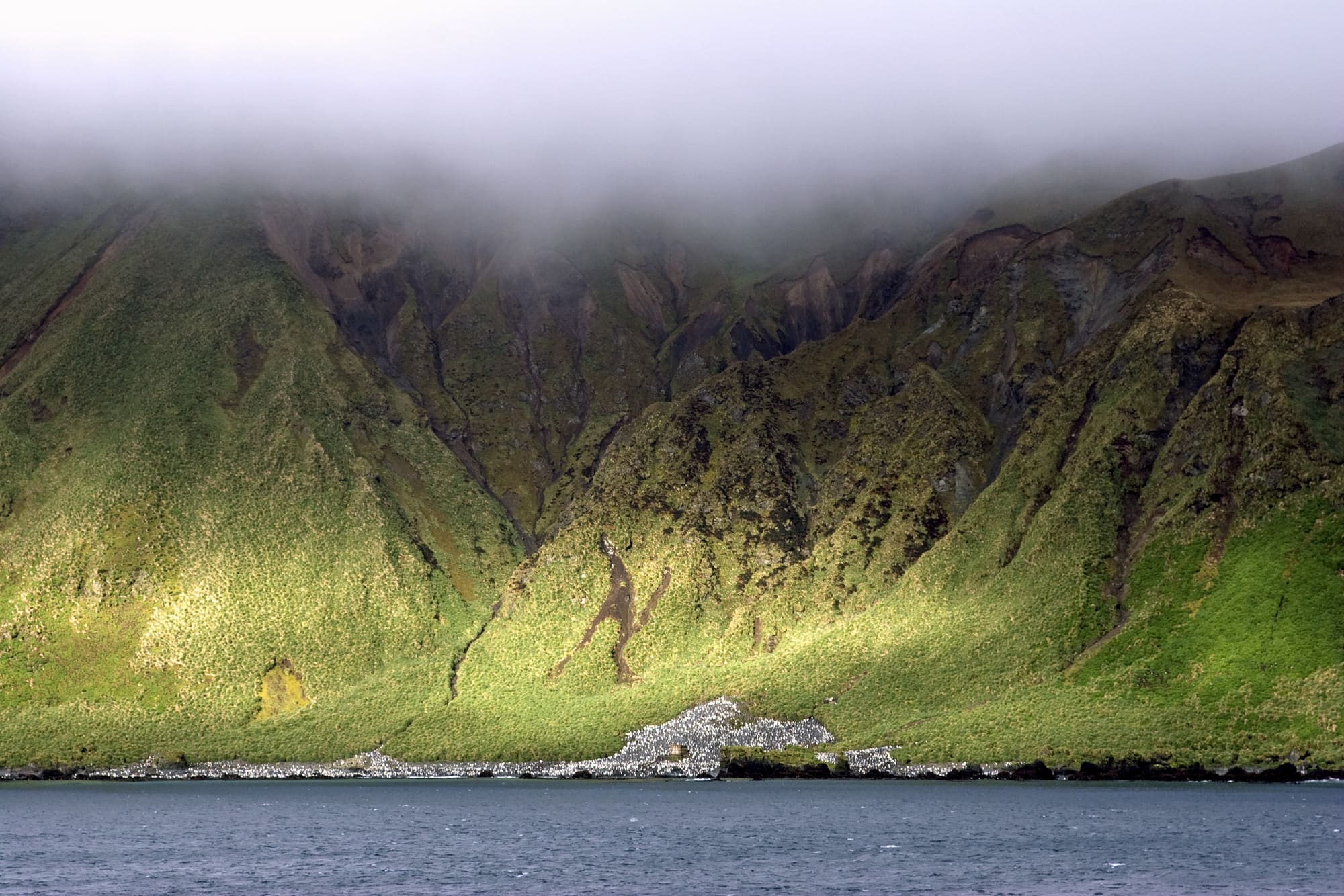
Macquarie Island is a long, narrow, treeless ridge of green and gold in the Southern Ocean, about 1,500 km south-east of Tasmania and roughly halfway to Antarctica. It measures about 34 km from end to end and only about 5 km across at its widest, and it belongs to the Australian state of Tasmania. The people who work there call it Macca. There's no town and no tree anywhere on it.
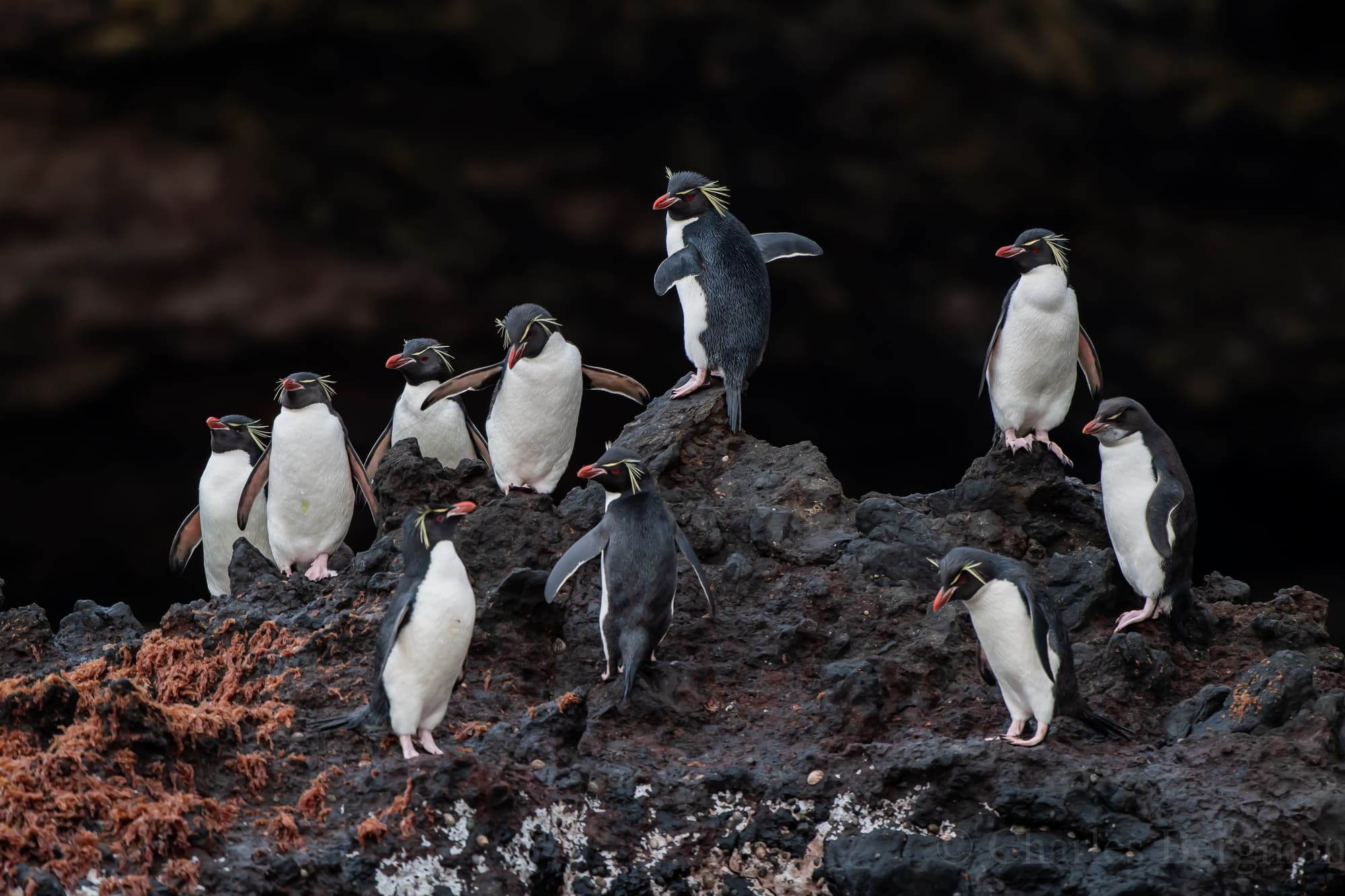
What draws people is the ground and what lives on it. This is the only island in the world made entirely of ocean crust and rock from the Earth's mantle, shoved up from the seabed along a plate boundary. Around it, more than 750,000 pairs of royal penguins (a species found breeding nowhere else) come ashore each year, alongside king penguins, elephant seals and several kinds of albatross and petrel.
Hardly anyone lives here. In 2026 the only residents were 24 staff at an Australian research station on the narrow isthmus at the northern end, and the plan then was to bring them home. The rest of the human traffic is the occasional expedition ship.
02
How it formed
How a piece of seafloor ended up above the waves, and what people did once they found it
Start with the ground, because it's the whole reason the island exists. Macquarie sits on the Macquarie Ridge, a mostly underwater chain of crests that runs south of New Zealand along the line where the Pacific and Indo-Australian plates meet. The island is the part that pokes above the surface. Its rocks began on the seafloor: pillow basalts (lava that cooled in rounded lumps underwater) and the deeper layers of crust and mantle that normally lie buried far below any ocean. Slow collision along the plate boundary squeezed them upwards, and the area is still seismically active. Published ages for the rocks differ between studies, so no number appears here.
Life arrived the usual way, by wind, water and wings. With no trees and no land mammals, the island grew tussock grass, boggy plateau and big-leaved plants called megaherbs, such as the Macquarie Island cabbage (Stilbocarpa polaris). At least 28 native vertebrates breed there, and two species, the royal penguin and the Macquarie Island shag, are found nowhere else.
People came late. Captain Frederick Hasselborough of the brig Perseverance sighted the island on 11 July 1810, on a sealing voyage out of Sydney, and named it for Lachlan Macquarie, the governor of New South Wales. The Australian Antarctic Division adds that Polynesians or other earlier visitors may have got there first, though nothing says they did. Hasselborough reported millions of penguins and around 250,000 seals. The sealers who followed were after oil and skins, and they were thorough.
The numbers are hard to read calmly. An estimated 200,000 to 400,000 fur seals lived on the island, and at least 120,000 were killed in the first 18 months of commercial sealing. The fur seals were almost wiped out within about a decade. Elephant seals, taken for their oil, had fallen by 70% by the mid-1840s. Then the hunters turned to penguins. After the king penguin colony at Lusitania Bay was devastated they moved on to royal penguins at a place called The Nuggets, and by 1905 the plant there could boil down 2,000 penguins at a time, each giving about half a litre of oil. The works closed in 1920, when the lease held by Joseph Hatch was cancelled.
Science got there next. In 1911 Douglas Mawson's Australasian Antarctic Expedition set up the island's first scientific station, with a wireless relay on Wireless Hill, which became the first radio link between Australia and Antarctica. Mawson's book records that five men landed in December 1911 and stayed almost two years. The Commonwealth Meteorological Service carried on the weather observations from 1913, until the relief ship Endeavour was lost with all aboard in 1914 and the observations stopped. The current station was founded on 21 March 1948 by the Australian National Antarctic Research Expeditions, and it has run ever since.
Protection came in steps. The island became a wildlife sanctuary in 1933, a Tasmanian nature reserve in 1978 and a World Heritage property in 1997. The first nomination, built mainly on the island's animals, didn't succeed. After the Committee deferred its decision in 1996 and asked for more comparison with other places, it agreed to the inscription at its meeting in Naples in December 1997. A Commonwealth marine park of 16.2 million hectares followed in 1999.
The hardest chapter was the animals people brought. Introduced predators and grazers wiped out two native bird species, stripped vegetation and set the soil moving. The fix was an eradication of rabbits, rats and mice together, which had not been done on an island this big: a project costing about A$25 million over seven years, in which a release of calicivirus and aerial baiting cut the rabbits, and hunters finished the job. A 12-person team with 11 hunting dogs spent 13 months combing six blocks of the island, and found eight adult rabbit survivors and a single litter. In 2013 rodent-detection dogs from New Zealand found no rats or mice. In April 2014 the project manager, Keith Springer, reported nothing seen for two and a half years. Nobody could realize the full effect on the land straight away, and ecologists said a new balance could take up to 20 years to settle. Tussock and megaherbs were already coming back, and blue petrels and Antarctic terns, once confined to offshore rock stacks, had begun breeding on the main island again.
03
Timeline
From seabed to nature reserve, with sealers, radio operators and rabbit hunters in between
Ocean crust and mantle rock are thrust up from the seabed along the Macquarie Ridge
Frederick Hasselborough sights the island on 11 July and sealing begins
Elephant seal numbers have fallen by 70% after years of hunting for oil
The penguin-oil plant can process 2,000 birds at once
Mawson's expedition builds the first scientific station and a wireless relay on Wireless Hill
The island is declared a wildlife sanctuary
The Australian National Antarctic Research Expeditions found the station on 21 March
It becomes the Macquarie Island Nature Reserve under Tasmanian law
The Committee inscribes the island after an earlier nomination fails
The Commonwealth marine park, 16.2 million hectares, is declared around the island
Rabbits, rats and mice are declared eradicated after a seven-year project
Australia announces the temporary withdrawal of station staff because of bird flu risk
04
Why visit
Penguins by the hundred thousand, on rock that began life under the sea
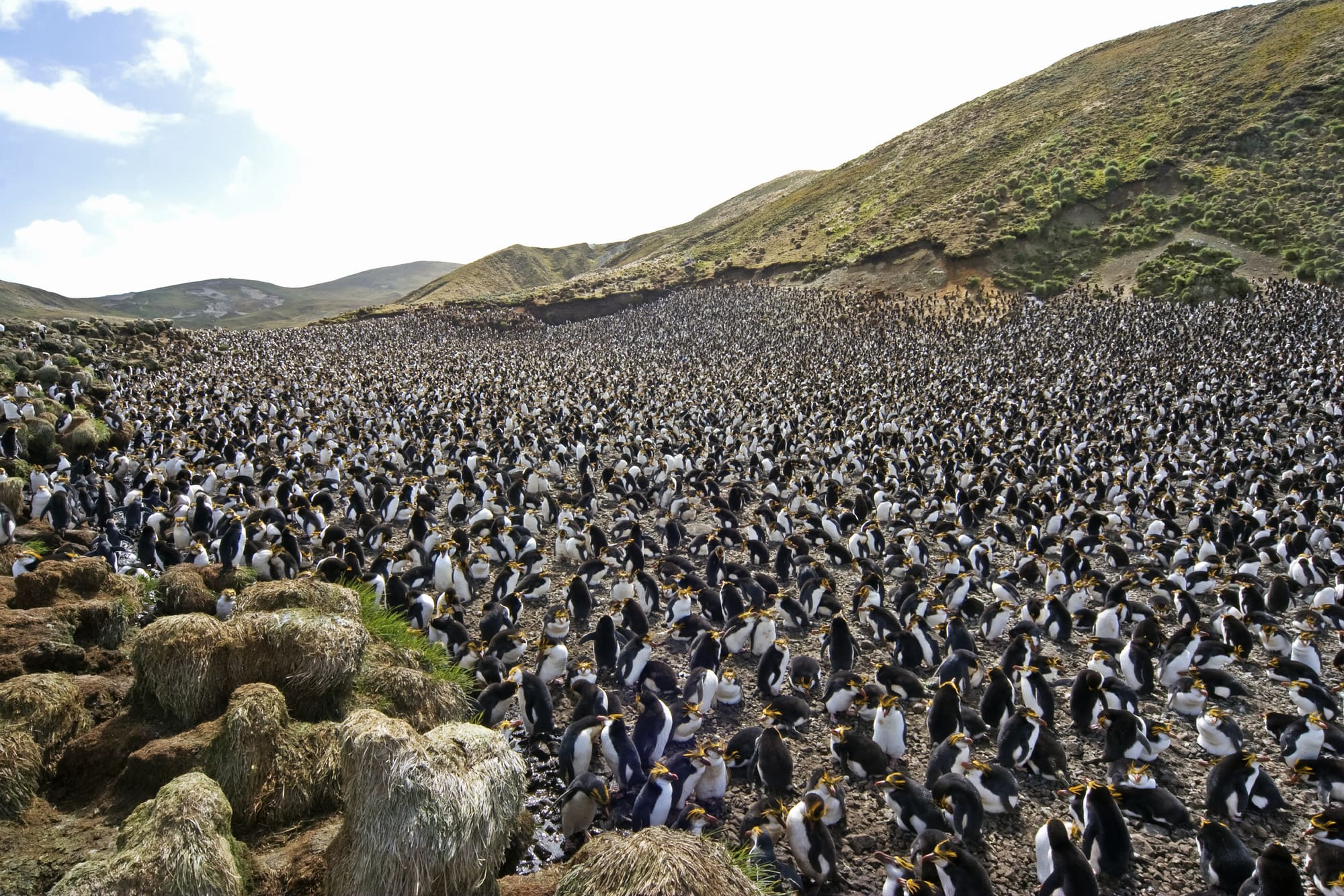
Few places on Earth put so many animals in front of you at once. At Hurd Point, on the southern tip, operator accounts describe some 300,000 royal penguins spread over the slopes, and one writer called it penguins as far as the eye could see. At Lusitania Bay about 100,000 king penguins crowd a beach where rusting boilers still sit among them. On the sand at Sandy Bay, elephant seals about 4 m long and weighing around a tonne lie in heaps,.
The ground is a draw in its own right. Nearly everywhere else, ocean crust and mantle rock are buried beneath kilometres of water. Here, the Macquarie Ridge has lifted a piece of that hidden floor clear of the waves, and the pillow basalts, shaped over millions of years by the sea, are among its finest rocks. Standing on it is a strange feeling even for people who couldn't tell basalt from breeze block, and the ground is not finished moving: the island is still seismically active, because the plates beneath it keep grinding.
Macquarie also tells a story you can read in the landscape. The boilers at Lusitania Bay are what is left of an industry that boiled penguins into oil. The tussock and megaherbs creeping back over the slopes are the result of a project that removed rabbits, rats and mice, and the blue petrels and Antarctic terns now breeding on the main island are the reward. Few places show so plainly both what people can destroy and what they can repair, and the answer isn't tidy yet.
And then there's the sheer remoteness. The island sits at 54 degrees south, in the zone sailors call the furious fifties, where wind gusts of 185 km/h have been recorded. Visiting needs a permit and a ship, and the numbers allowed ashore are limited.
05
The setting
A narrow island on a submerged ridge, windswept, wet and far from anywhere
Macquarie lies at 54°38' south, 158°52' east. It is about 1,500 km south-east of Tasmania and about 1,300 km north of the Antarctic continent, roughly halfway between Tasmania or New Zealand and Antarctica. Its nicknames, Macca and the Green Sponge, describe it well: a spongy, boggy island. It's about 34 km long and about 5 km across at its widest, around 12,785 hectares of land, a long thin finger, roughly one and a half times the length of Tasmania's Freycinet Peninsula.
The land rises from a skirt of coastal tussock to a high plateau of golden grasses, where streams run between small lakes and bogs. More than 42 lakes are scattered across it. Higher still lies feldmark, a bare, gravelly terrace habitat of mosses, lichens and cushions of the endemic plant Azorella, bashed by the strongest winds. No trees grow anywhere. The research station stands on a low neck of land at the northern end, the isthmus, with Wireless Hill rising behind it.
The weather decides everything. The wind averages about 25 km/h through the year and has gusted to 185 km/h at sea level, and the plateau is windier still. The center of the island, the plateau, takes the worst of it.
Two sets of lines are drawn on the map. The nature reserve covers the island, the outlying islets (Judge and Clerk, and Bishop and Clerk) and the water out to three nautical miles. The World Heritage area is bigger, taking in the whole reserve and Australian waters out to 12 nautical miles, which is why the listed area is so much larger than the island.
06
Zones and trails
A few landing beaches, three great colonies and a hill with a radio history
Sandy Bay
The beach where operator accounts describe shore visits. King penguins, royal penguins and elephant seals share the shingle, and the penguins walk to and from their colonies past the sleeping seals. Elephant seals are about 4 m long and around a tonne, so the polite thing is to let them have the right of way. Expect to spend a morning here and then return to the ship for lunch. Overcast and cold is normal, and snow showers have been recorded by the evening in early summer.
Lusitania Bay
A beach on the island's coast with a king penguin colony of about 100,000 birds. Beside the penguins lie the rusting boilers of the penguin-oil industry, which hit this colony first before moving on to the royal penguins at The Nuggets. It's a place where history and wildlife share a few square metres, and the contrast is the point. Operator accounts describe it from the water, so binoculars and a decent lens will help to pick out the detail.
Hurd Point
The southern tip of the island, with the largest royal penguin colony: about 150,000 breeding pairs, or around 300,000 birds. The royal penguin breeds only on Macquarie, which gives the sight extra weight. Operator accounts describe sailing south down the east coast past other colonies to reach it, and the view is from the water. The point is exposed, so the sea state and the light can change quickly. It's best on a clear afternoon, when the whole slope is moving.
Wireless Hill and the isthmus
At the narrow northern neck of the island stands the working research station, with Wireless Hill behind it. Here Mawson's party set up its radio masts in 1911, and a hut on the summit served as the operating room. Today the station staff, the Bureau of Meteorology team and the rangers work from the isthmus. The station itself is a workplace, not a visitor stop, so any access depends on the staff and the rangers.
The plateau and its lakes
Above the coast, the island opens into a broad plateau of golden tussock, bogs and more than 42 lakes, with feldmark on the highest ground. The Azorella cushion plant covers the upper terraces, though disease has hit it hard. The operator accounts we found stay on the coast, so most visitors will only look up at the plateau from the shore. Anyone who does get inland should expect wet ground, wind and very little shelter. It's a landscape of subtle tones, and worth knowing about even from below.
07
What to expect
Cold, wet, loud and crowded with birds, but only for as long as the weather allows
Be ready for weather first and wildlife second. The wind on Macquarie averages about 25 km/h all year and has gusted to 185 km/h, so a waterproof shell, windproof layers, gloves and a hat that stays on matter more than anything else you pack. Operator accounts from the summer season describe overcast mornings and, once, snowflakes falling at dinner. As at any exposed landing, the sea has the last word on whether you get ashore at all.
A visit is a series of hours rather than days. One operator's account describes a morning ashore at Sandy Bay, photographing king and royal penguins and elephant seals, then back to the ship for lunch. In the afternoon the ship sailed down the east coast, passing colonies on the way to Hurd Point at the southern tip. Evenings were talks and dinner aboard. The writer called it surreal, and noted that the animals were curious about the visitors, not afraid of them.
The crowd, in a sense, is the penguins. The island's own description is roughly one seabird or seal per square metre, though that is a figure of speech and not a census. Expect noise and the smell that goes with many thousands of birds and seals. Most of the color comes from the tussock turning the plateau gold, because everything else (sea, sky, shingle) tends to be grey.
As far as we could tell there's nowhere ashore to buy a drink or shelter from the wind. The research station is a workplace, not a visitor stop. The nearest café is about 1,500 km away in Tasmania, so eat before you land. Operator accounts show short stays on the beach rather than long walks. Pack boots and clothing you can scrub clean: the island has been free of rats, mice and rabbits since 2014, and biosecurity is taken seriously.
08
Photographs
More of the place, as it looks on the ground
09
Planning your visit
A permit, an expedition ship and a flexible plan
Best months
- January: best
- February: best
- March
- April
- May
- June
- July
- August
- September
- October
- November: best
- December: best
November to February
- Time needed
- One to two days ashore, within a voyage of about two weeks or more
- Crowding at peak
- Quiet
- Access
- A Tasmanian permit is required. Tasmania Parks and Wildlife Service limits visitors per season and ashore at one time. The tourist visits described by the Australian Antarctic Division are by ship.
- Accessibility
- Accessibility information is limited; contact the site before travelling.
- Services
- No servicesNo facilities; visits need full self-sufficiency or an operator
Practical details checked on
Plan on one or two days at the island itself, and a much longer voyage around it. The Australian Antarctic Division describes two ways to go. The first is a stopover of a day or two on a voyage of three weeks or more, bound from Hobart or the south of New Zealand to East Antarctica. The second is a shorter voyage of about two weeks that visits Macquarie with New Zealand's subantarctic islands, such as Campbell Island and the Auckland Islands, usually with a bird-watching focus. Its guidance on tourism was last updated in 2006, so check the details with the operator.
Every visit needs a Tasmanian permit, and Tasmania Parks and Wildlife Service sets limits on visitors per season and on how many are ashore at one time. Ask your operator who holds the permit and what happens if landings are called off.
Summer is the season. Operator accounts we found describe visits in November, December, January and February, and rangers manage educational tourism visits during the summer months.
Bird flu adds a real question mark for 2026 and 2027. On 28 August 2026 the Australian Government announced it was withdrawing the station's 24 staff because of the risk of an H5 outbreak, though the virus had not been detected on the island. Ask your operator how that affects landings, and ask early.
On-site services
There are no visitor facilities. The research station is a working base for its own staff, not a place to drop in for a coffee or a bed. Visitors arrive by ship, spend a few hours ashore and go back aboard for meals and a night's sleep, as one operator's account of a day at Sandy Bay shows. Bring what you need for a day outdoors in cold, wet, windy weather. We could not confirm mobile signal, toilets or drinking water ashore.
10
Getting here
No airport, no ferry timetable, only an expedition ship from Hobart or New Zealand
There's no regular way to reach Macquarie Island. We found no flights and no scheduled boats, and the sources describe tourist access only by ship. The island sits about 1,500 km south-east of Tasmania, so every visit is a sea voyage, and the island is usually one stop on a longer trip.
Ships that visit leave from Hobart, in Tasmania, or from New Zealand's South Island. They come in two kinds. Some are long expeditions towards East Antarctica, often the Ross Sea, that call at Macquarie for one or two days along the way. Others are shorter subantarctic voyages of about two weeks that link Macquarie with Campbell Island and the Auckland Islands. Either way, you travel as a passenger on an expedition vessel with an operator that holds the Tasmanian permit.
Typical sailing times, fares and the list of approved operators: Could not be confirmed at the time of writing.
The approach is part of the experience. Macquarie sits at 54 degrees south, in what sailors call the furious fifties, and the Southern Ocean doesn't care about your itinerary. A stopover is a day or two inside a voyage of three weeks or more, so most of your time is spent at sea. The shorter destination voyages of about two weeks give Macquarie more of the schedule, and tend to be built around birds.
Landings are limited, and as far as operator accounts show, the beach at Sandy Bay is the usual place. Other sights, such as Lusitania Bay and Hurd Point, are seen from the water. The research station is a working base and doesn't accept casual visitors.
For the supply of the station itself, the Australian Antarctic Division's icebreaking research and supply vessel, RSV Nuyina, is used. It is not a passenger service. In 2026 it was due to collect the station's staff in late September or early October, which shows how much the timing of ships can shift with events. Travel to the island may be affected by bird flu precautions, so confirm everything with the operator before you commit.
Entry rules depend on your nationality and on the port you sail from, so check the official Australian and New Zealand government immigration sites for your own situation. Weather can delay or cancel a landing.
11
Local culture
A community of rangers, weather observers and scientists on the last stop before the ice
No one lives on Macquarie Island permanently. The only residents are the people who work there on tours of duty, and in 2026 that meant 24 expeditioners. They are scientists, tradespeople and support staff at the Australian Antarctic Division's research station on the northern isthmus, which has run continuously since 1948 and is the longest-running Australian station in the subantarctic or Antarctica.
Several agencies share it. Bureau of Meteorology staff have kept weather records since the station began. The station helps monitor carbon dioxide and ozone, and ARPANSA, the Australian radiation protection agency, runs year-round monitoring to help detect nuclear explosions under the Comprehensive Nuclear Test Ban Treaty. Tasmania Parks and Wildlife Service has managed the nature reserve day to day since the early 1970s, and it keeps two rangers on the island at a time, generally for 12 months. The rangers also organize the educational tourism visits during the summer months.
The island has no Indigenous community that we could find a record of. The Australian Antarctic Division says Polynesians or other earlier visitors may have reached it before 1810, but nothing documents it. Human history here begins with the sealers, the penguin-oil workers and then Mawson's party, whose wireless operators worked in a hut on Wireless Hill.
Daily life is practical and quiet. The station community depends on a ship for supplies, and the staff live alongside a colony of about 2,500 elephant seals beside the base, according to ABC News.
The station's future is under discussion. About $370 million over nine years has been set aside to replace buildings at risk from ocean inundation and landslips, and the government says the decision to rebuild stands, though the 2026 withdrawal will slow it.
12
Anecdotes
Drowned sealers, radio silence and a rusty boiler with a nesting penguin
Frederick Hasselborough, who found the island, didn't live to enjoy the fame. Later in 1810 he went on to Campbell Island, and on 4 November he drowned there when his boat capsized, according to the accounts available.
Then there's the radio. Mawson's party couldn't talk to Hobart directly from Antarctica, so Macquarie was meant to relay the messages. At first the operators on Wireless Hill had no way of knowing whether they could hear anyone, or whether anyone could hear them. They could only transmit, wait and hope. A favorite detail is the engine house: Charles Sandell built it well away from the operating hut so that the noise of the generator wouldn't drown the faint signals Arthur Sawyer was listening for. They reached a ship in February 1912 and Suva, in Fiji, in March.
Daily life for Ainsworth's five-man party had its own details. They lived in a hut they called the Shack, collected rainwater in a tank salvaged from the wrecked sealing schooner Clyde, and ate mutton from sheep landed for the purpose at their first Christmas dinner. Wekas, flightless birds that people had introduced, shared the island with skuas and giant petrels, according to Mawson's book.
The penguin-oil boilers are still there. Some stand rusting at Lusitania Bay among the king penguins, which number about 100,000 today. It's an odd bit of reversal that the machinery built to boil the colony down is now part of the scenery the penguins walk past.
And one more: Mawson himself is reported to have called the island one of the 'wonder spots of the world', a line the island's conservation foundation still quotes.
13
Challenges
A recovered island now facing disease, a changing climate and a station to rebuild
The International Union for Conservation of Nature's 2025 World Heritage Outlook rates the island's prospects as good, with protection and management highly effective. No State of Conservation concern from the World Heritage Committee turned up in recent years, so the outlook is stable, but the same assessment names several serious pressures. The most urgent is a bird flu virus that has reached another Australian sub-Antarctic territory and could reach this one. The other concerns are disease in a native plant, a warming and wetter climate, and the rebuild of the research station.
- H5 bird flu: it has not been detected on Macquarie, but experts expect a high likelihood of a significant mortality event this breeding season. At Heard Island, average elephant seal pup mortality reached 76% in the final October surveys, and in August 2026 the Australian Government announced it would withdraw the station's 24 staff.
- Cushion-plant die-back: the endemic Azorella macquariensis is dying back across more than half of the island, and up to 90% of cushions in some areas. The IUCN links it to climate change interacting with a pathogen.
- Climate change: rainfall has risen by nearly 200 mm since the mid-20th century, temperatures have warmed about 0.5 °C, and coastal erosion is shrinking habitat. The elephant seal population has been falling by roughly 1 to 2% a year.
- Seabird declines: king penguin chick numbers have fallen since 2007, and the gentoo penguin population has declined about 1.8% a year over 34 years. The reasons are not always clear, so monitoring continues.
- Station rebuild: replacing the station is budgeted at about A$370 million over nine years. The IUCN notes possible quarrying and antenna strikes on seabirds, and classes the effect as data deficient while the plan is unsettled.
- Biosecurity: rabbits, rats and mice have been gone since 2014, and cargo is screened by dogs and traps. Non-native redpolls and starlings are present and not monitored, so keeping new pests out remains a daily job.
14
Travelling responsibly
Small habits that protect a restored island from new pests and disease
- Clean your boots, clothing and bags before you land. The island has been free of rats, mice and rabbits since 2014, and one stowaway could undo a A$25 million project.
- Follow your guide's and the ranger's instructions about where to stand and how close to go. Breeding birds and seals are easily disturbed.
- Give elephant seals plenty of room. An adult is about 4 m long and weighs around a tonne, so keep out of its way.
- Don't fly a drone unless your operator and the ranger have said it's allowed. Low-flying machines can frighten breeding birds, and the island's wildlife has little cover.
- Don't touch, feed or chase any animal, and never handle dead birds or seals. H5 bird flu hasn't reached the island, and nobody wants to carry it there.
- If you've recently handled poultry or wild birds, tell your operator before you land: bird flu can travel on clothing and equipment.
- Take all your rubbish back to the ship: the nearest tip is about 1,500 km away, and litter harms seabirds.
15
In the news
Recent reporting, summarised
· Australian Antarctic Division
Department of Climate Change, Energy, the Environment and Water to remove Australian Antarctic Program expeditioners from sub-Antarctic island as H5 bird flu threat approachesThe 24 station staff are being withdrawn temporarily because of the risk to their wellbeing from a likely bird flu outbreak among the island's wildlife.
· ABC News
Australia to withdraw staff from Macquarie Island due to 'psychological risk' of bird fluThe report adds that up to 90% of elephant seal pups could die, and that the A$370 million station rebuild will be slowed.
· Australian Antarctic Division
Australian Antarctic Program scientists finalise H5 bird flu findings from Heard Island and McDonald Island voyagesSurveys at Heard Island found heavy elephant seal pup deaths from H5N1, the first detection in an Australian external territory, and no suspected cases on Macquarie.
16
Frequently asked questions
The questions travellers ask most
Can you visit Macquarie Island?
Yes, but only on a ship voyage and with a Tasmanian permit. Tasmania Parks and Wildlife Service sets limits on visitor numbers each season, and your operator handles the permit. Bird flu in 2026 may change what's allowed, so ask the operator directly.
How long do you get ashore?
Usually a day or two. The Australian Antarctic Division describes a one or two day stop within a longer voyage, or as the focus of a voyage of about two weeks. Weather can shorten or cancel the landing.
Is there anywhere to stay on the island?
We found no visitor accommodation. The station is for its staff, and the operator accounts we read show guests going back to the ship for lunch and overnight. Plan to sleep aboard.
Which penguins can you see?
Royal penguins, which breed only on Macquarie, king penguins and gentoo penguins all nest there, with royal penguins by far the most numerous at over 750,000 breeding pairs. King penguins are seen at Lusitania Bay and Sandy Bay, and royal penguins at Hurd Point and Sandy Bay.
Will bird flu affect a visit?
It might. On 28 August 2026 the Australian Government said H5 bird flu had not been detected on the island, but it was withdrawing the station's staff because expert assessments said a serious outbreak was likely this breeding season. Operators and the rangers decide what is safe, so ask before you go and expect plans to change.
Why is it called Macquarie Island?
Captain Frederick Hasselborough, who sighted it on 11 July 1810 on a sealing voyage from Sydney, named it after Lachlan Macquarie, the governor of New South Wales. Mawson and others later made it a base for radio and weather work.
17
Location
Where the island sits between Tasmania, New Zealand and the ice
There is no town on the island. The nearest settled places are a long way off. Tasmania lies about 1,500 km to the north-west, and visiting ships sail from Hobart or from the south of New Zealand's South Island. Antarctica is about 1,300 km to the south.
The island itself is a long finger running roughly north to south. The research station and Wireless Hill occupy the isthmus at the northern end, where the land narrows to a neck. Operator accounts describe sailing down the east coast, past penguin colonies, to Hurd Point at the southern tip. The plateau fills the island's middle, with bogs and more than 42 lakes.
Two groups of small outlying islets, Judge and Clerk and Bishop and Clerk, also belong to the reserve.
Across the Southern Ocean lie New Zealand's subantarctic islands, Campbell Island and the Auckland Islands, which expedition ships often combine with Macquarie on a single trip. Together they form a separate World Heritage property.
Macquarie Island is about 1270 km south-west of Dunedin.
Nearest towns and cities
- Invercargill · about 49,000 peopleabout 1130 km north-east
- Dunedin · about 118,000 peopleabout 1270 km north-east
- Timaru · about 27,000 peopleabout 1440 km north-east
- Hobart · about 81,000 peopleabout 1560 km north-west
- Christchurch · about 363,000 peopleabout 1580 km north-east
- Launceston · about 72,000 peopleabout 1700 km north-west
18
Around the site
Places worth the detour, and the nearest World Heritage neighbours
No other World Heritage sites lie within 600 km.
19
Further resources
Books, links and people who know the ground
Books
- The Home of the BlizzardDouglas Mawson, 1915
- One Small Island: The Story of Macquarie IslandAlison Lester and Coral Tulloch, 2019
Links
The official record
- World Heritage Centre page for this sitewhc.unesco.org
- Australian Antarctic Division: Macquarie Island station historyantarctica.gov.au
- Australian Antarctic Division: tourism frequently asked questionsantarctica.gov.au
Trip reports
No one has written up a visit to Macquarie Island yet. If you have been, we would like to hear how it went.
Been here? Share a trip reportGuest reports are credited and edited with you before they appear.
Suggest a correction or additionEvery message is read by an editor.
Last reviewed