Pearling, an Island Economy
Also known as Pearling, Testimony of an Island Economy, Bahrain Pearling Trail, Muharraq pearling sites
Merchant houses, a fort and offshore oyster beds from when Bahrain lived on pearls.
Supported byFirst Sponsor
01
Introduction
A town built on one industry, and the sea beds that fed it
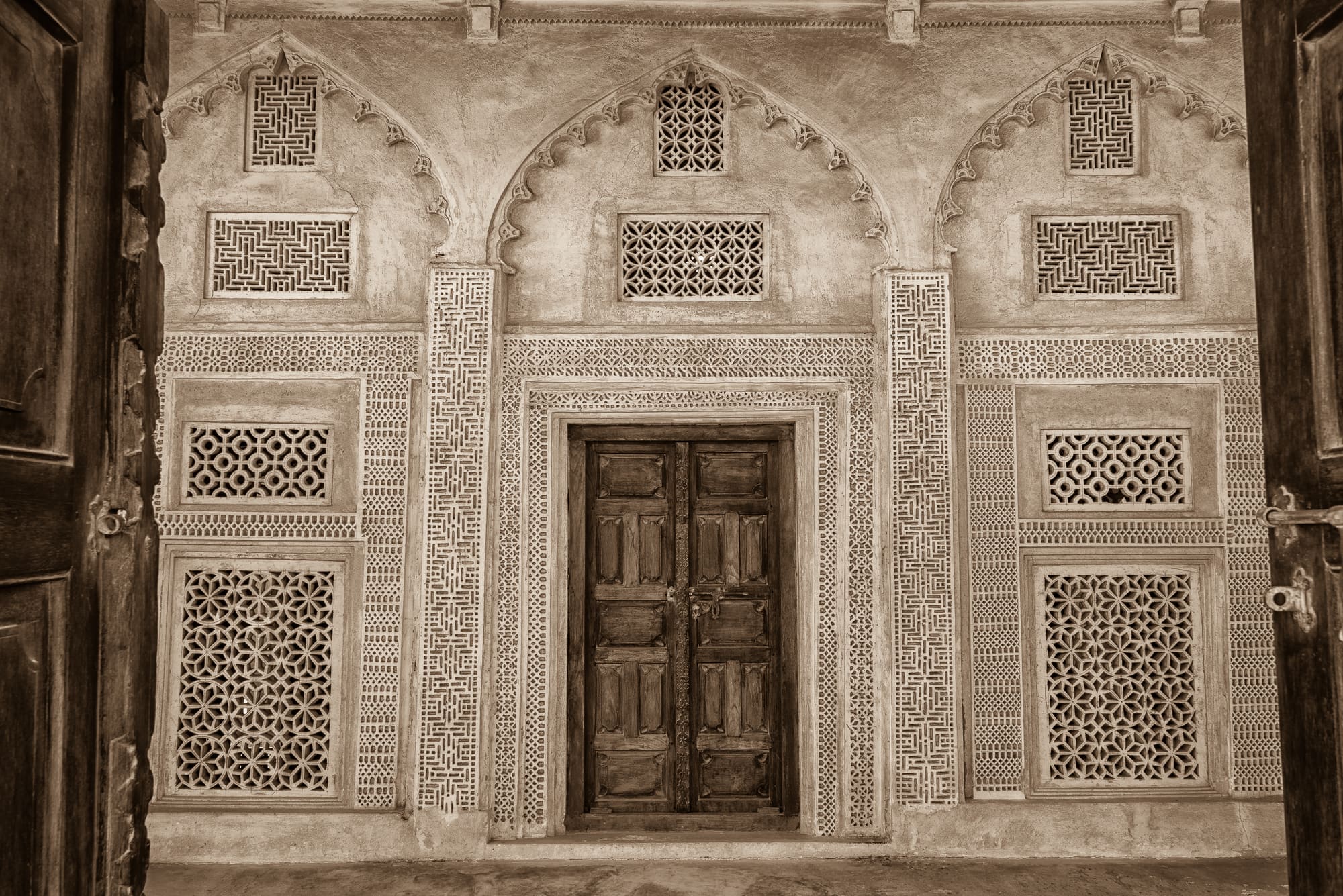
Pearling, Testimony of an Island Economy is a walking trail through the old part of Muharraq, the island city across the harbour from Bahrain's capital, Manama. It strings together 17 buildings (merchants' houses, shops, a reception hall, a mosque and a diver's home), a partly surviving seafront fort and three oyster beds that lie out in the water to the north. All of it records one business: fishing for natural pearls, which kept Bahrain afloat until the early 20th century.
The property was inscribed, meaning entered on the World Heritage List, in 2012. What makes it unusual is how ordinary most of it is. There are no palaces. The route runs from a ship captain's guest rooms to a pearl dealer's majlis (a reception room) to the storehouses that sold boat timber and groceries. It's a story about money, debt and the sea, told in coral stone. The oyster beds are the odd part: about 35,000 hectares of open water, so nearly all of the protected area is sea. Nobody walks that bit.
People still live here. The grandson of the man who built Siyadi House lives in it. The eastern half of Fakhro House is a family home, and the Siyadi Mosque is used for prayer. Treat it as a residential quarter that happens to have a trail through it.
02
History
From ancient pearl beds to a merchant capital, a crash and a careful rescue
Pearls from the waters north of Bahrain were being traded long before anyone in Muharraq built with coral stone. The Pearling Path's own history pages say that fishing for natural pearls on these beds dominated the Gulf from at least the third century BCE, and pierced pearls found at Gulf coastal sites date to about 5,000 BCE. The Roman writer Pliny the Elder, who died in 79 CE, called the island (then known as Tylos) 'extremely famous for its numerous pearls'.
Muharraq's own moment came much later. It was Bahrain's capital from 1810 to 1923 and, at the peak, the busiest pearling town in the Gulf, with the most divers and the biggest fleet. Almost everyone in town worked directly in pearling or in the trades that supplied it. The town grew from clusters called firij, each organised around a mosque or a majlis and held together by family ties. Coral stone, rather than the palm-leaf barasti of smaller Gulf settlements such as Dubai around 1900, set Muharraq apart. Houses were plain on the outside and private within, with woodwork that shows Persian influence, doors and windows that came in along Indian trade routes, and patterns from elsewhere on the Arabian Peninsula.
The year ran on one season. Departure day, Al Rakbah, was announced by the head of state a few days ahead, and women sang farewell songs. The main diving season, Al Ghus Al Kabir, kept the fleet away for about four months. A crew could be fewer than ten men or more than a hundred; a big dhow carried 60 to 80. The captain, the nukhidhah, set the course. Divers (ghis) went down, haulers (sib) pulled them up. The tabbab, who fetched water and washed clothes, was usually a boy of nine to 13.
Debt held it together. Merchants advanced money to captains, captains passed loans to divers for their families, and a bad season simply carried the debt forward. It's easy to realize how a family could get trapped. Until the pearling reforms of the 1920s a diver's unpaid debts passed to his next of kin. Trades on land grew alongside: storehouses called amarat sold boat-building materials, and the merchants known as tawawish sold pearls on to the world. Pearls made up three quarters of Bahrain's exports in 1877. By 1904 to 1905 an estimated 97.3% of the Gulf's pearl trade passed through Bahrain, and the value of exports rose sixfold between 1900 and 1912. In 1912 Jacques Cartier arrived to buy.
That was the peak, 1911 to 1912, and then the sums stopped adding up. Wars, price crashes, cheap cultivated pearls, the Wall Street crash and riots by divers over lost income all played a part. Cultured pearls from Japan reached the market around the 1930s and hit Bahrain's natural pearl business hard. By 1950 the trade had almost entirely collapsed. Bahrain answered in law: a public notice in 1928 banned selling or possessing cultured pearls for trade, and the rule is still enforced.
Oil and gas took over the economy. Manama, across the harbour, grew; Muharraq's role shrank. Much of the old street pattern survived. Two excavated sites, Bu Maher and Muharraq, were declared national monuments on 10 January 2010. Conservation work has been under way since 2011, and the property was inscribed in 2012.
The story didn't stop at inscription. In 2017 the northern oyster beds were declared a Marine Protected Area, and in 2019 the wider revitalisation of Muharraq won an Aga Khan Award for Architecture. The path itself, with its new squares and visitor centres, is a 21st-century job laid over a 19th-century town.
03
Timeline
Two thousand years of pearls, a century of boom and bust, then restoration
Natural pearl fishing on the northern beds already dominates the Gulf
A Portuguese map shows the four-towered fort at Bu Mahir
Muharraq becomes Bahrain's capital, a role it keeps until 1923
British naval forces destroy much of Qal'at Bu Mahir
Pearls make up three quarters of Bahrain's exports
The pearling economy reaches its peak
Jacques Cartier visits Bahrain to learn how to buy natural pearls directly
A public notice bans selling or possessing cultured pearls for trade
Cultured pearls from Japan reach the market and hit Bahraini pearling hard
The pearling economy has all but collapsed
The Bu Maher and Muharraq sites are declared national monuments
Inscribed on the World Heritage List as Bahrain's second site
The northern oyster beds are declared a Marine Protected Area
The revitalisation of Muharraq wins an Aga Khan Award for Architecture
04
Why visit
One industry followed from the shoreline to the merchant's reception hall
Few heritage trails are built around a single trade, and fewer still can follow it link by link. This one starts at the shore where the fleets left, passes the captain's guest rooms, the dealers' reception halls and the storehouses, and ends among the shops where pearls were sold. The beds that supplied all of it sit offshore. The effect is of a whole trade laid out on the ground.
The buildings explain themselves if you read them as a map of money. Nukhidhah House was the majlis of a boat captain, Jassim Ajaj, with rooms for incoming divers. Murad Majlis, facing the family house across a small square, is where pearl sales were negotiated. The Fakhro family's house has its own private dock, because its owner, a timber and boat merchant, ran up to 50 boats. Beside the market, the ruin of a storehouse has been roofed over rather than tidied away, which says something honest about what happened to the trade.
It isn't only a story about merchants. Women ran households for months while the fleet was away, and Al Jalahma House, where women made up most of the household, shows how they shaped the architecture. Boys of nine to 13 worked the boats. A folk-medicine practitioner set up a small clinic in Badr Ghulum House in 1912. Debts crossed generations. The trail keeps those lives in view.
And it's lived in. A mosque built in 1865 is still in use. A four-storey guest building, the only one of its kind from the pearling era, now holds a pearl museum with pieces from the Cartier archive. New architecture, from a visitor centre built around old ruins to pearl-shaped streetlamps and floors inlaid with mother-of-pearl, sits among the old walls rather than replacing them. The wider revitalisation of Muharraq won an Aga Khan Award for Architecture in 2019.
05
The setting
A low coral-stone town on a flat island, facing shallow sea
Muharraq is an island city facing Manama across the harbour, and the Sheikh Isa bin Salman Causeway links it to the capital. The Pearling Path runs about 3.5 kilometres through the old town, from the Bu Mahir seashore at the southern tip of the island to the Siyadi complex in central Muharraq. A pedestrian bridge crosses the Khalifa Al Kabeer highway to connect the old city with the shore. Bu Mahir is the only natural coastline left on the island.
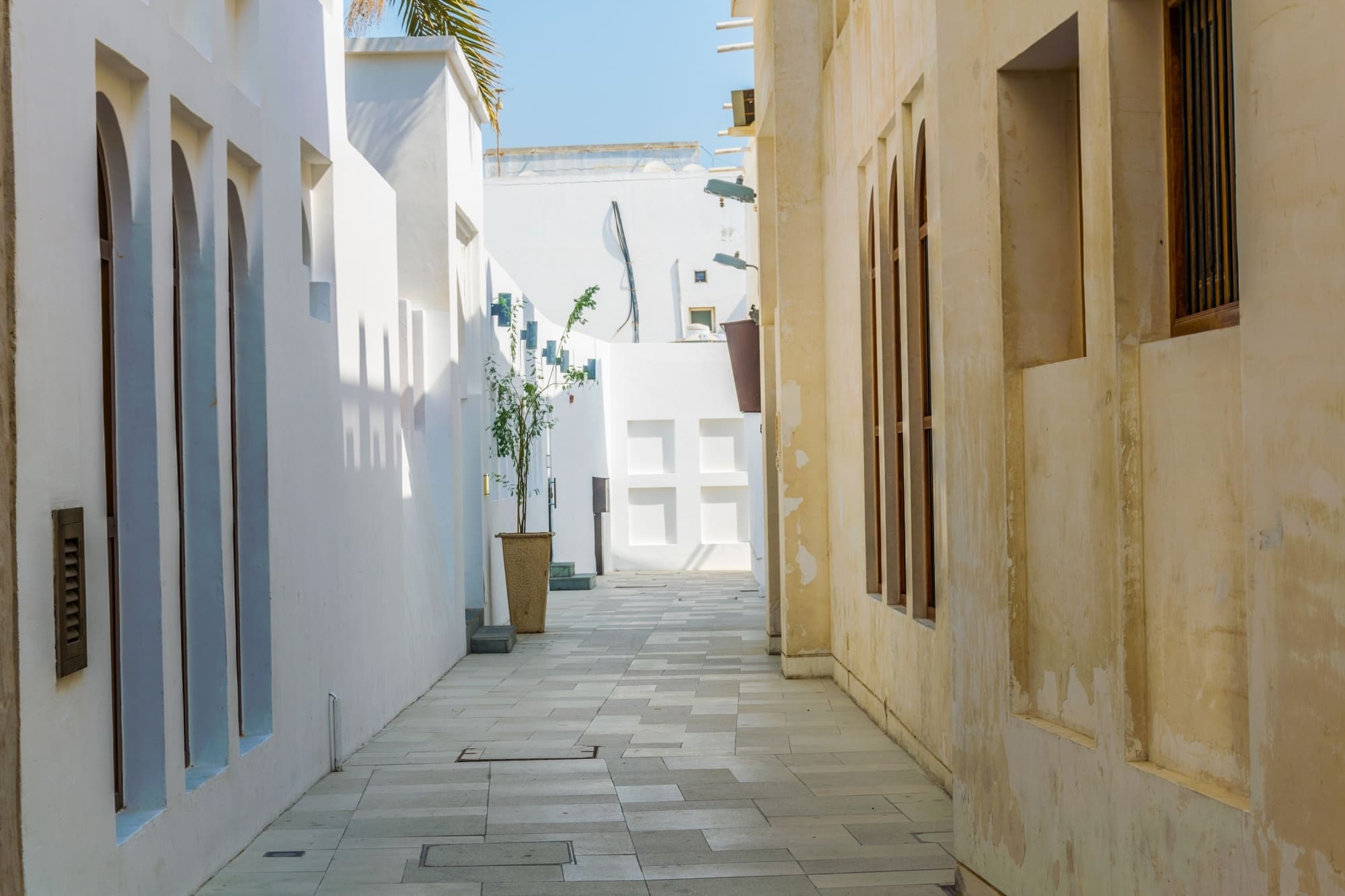
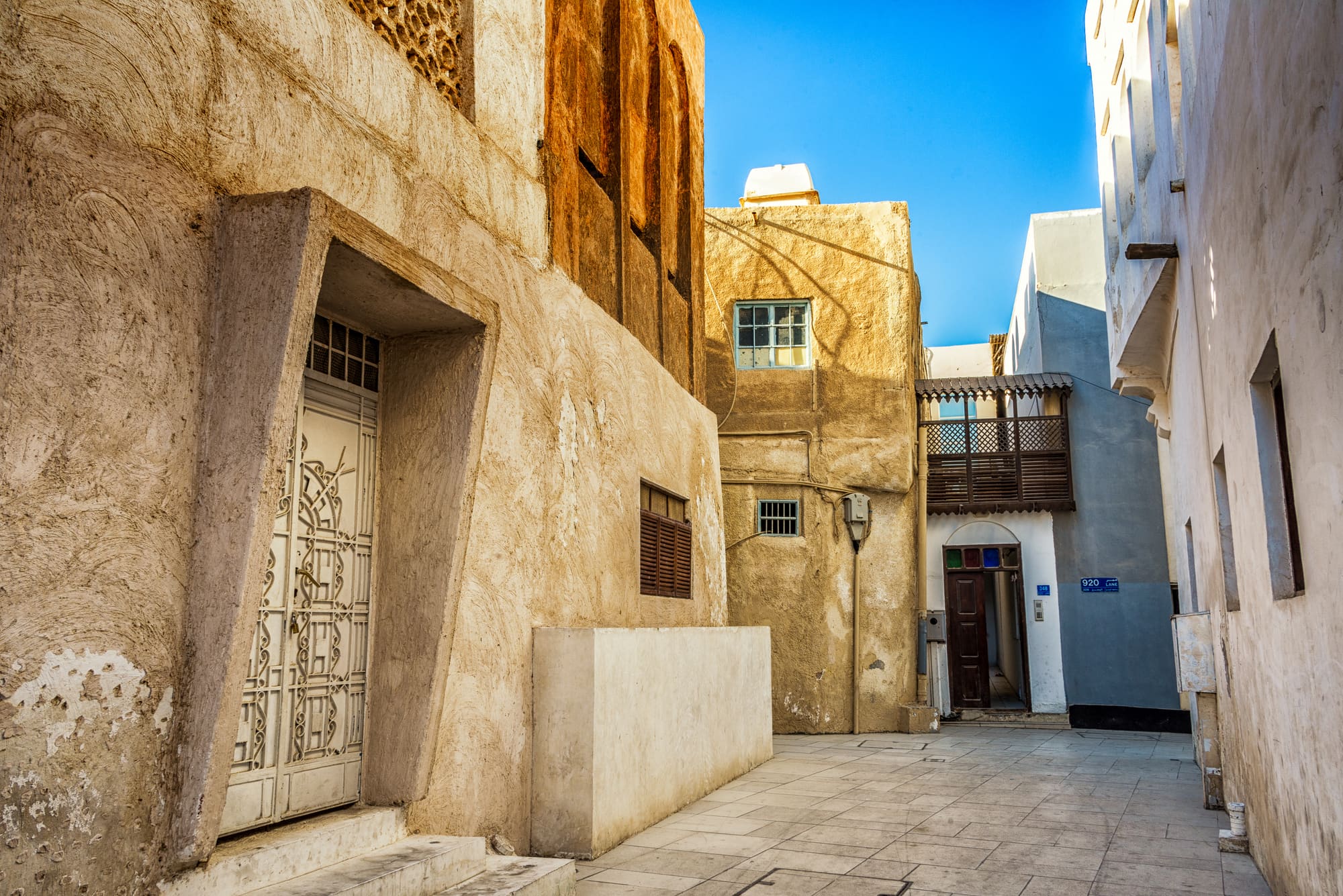
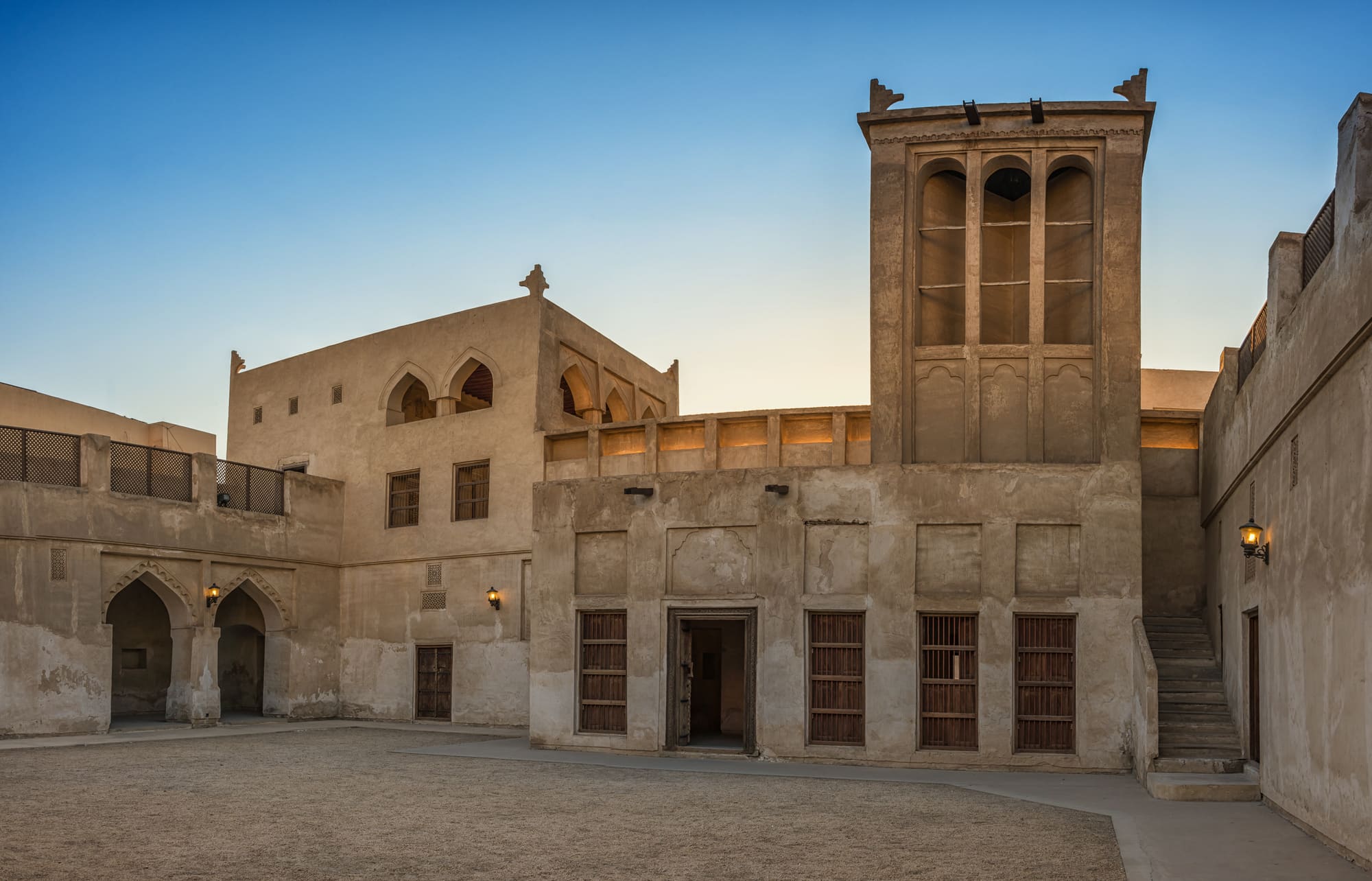
The old town is built mostly of coral stone, with courtyards, narrow lanes and a few wind towers. Coral stone is pale, and the color of the lanes shifts a lot with the light. Between the buildings, the path now passes 16 new public spaces with shade trees, steps, playgrounds and kiosks, and four multistorey car parks serve the route.
Offshore, the three oyster beds, Hayr Shtayyah, Hayr Bu 'Amamah and Hayr Bu-l-Thamah, cover nearly 35,000 hectares. A hayr is a flat, rocky seabed deeper than 10 metres, dominated by oyster habitat. They sit in a famously hard sea: temperatures swing between roughly 16 °C and 36 °C over the year, and salinity passes 50 parts per thousand in places. The property's buffer zone (the surrounding area that protects it) is about 95,900 hectares.
Climate is simple. Winter days in Manama peak at about 20 to 25 °C, and almost all the little rain falls in winter. From June to August daytime highs reach 37 to 39 °C. Outside the beds, the property is small enough to walk end to end in a morning, with the sea never far away.
06
The components
Eight pieces of one economy, from the shore to the offshore beds
Qal'at Bu Mahir and the seashore
A fort at the southern tip of Muharraq, first drawn on a Portuguese map of 1635. It had four towers and guarded the pearling fleet at the start and end of each season. British naval forces destroyed much of it in 1868, and today only the southern tower and its attached wing stand. Two other towers were excavated, and the foundations of the northern wall can be seen. The shore beside it was the departure and return point for the fleet, and the Bu Mahir Visitor's Centre is here. It's one of the places the official page lists as open to the public.
Nukhidhah House
The majlis of boat captain Jassim Ajaj, built in the 1920s a few metres from his family home. It had guest rooms for divers who arrived to join his boat, so it works as a small lesson in how a crew was gathered. The official page lists it as one of the buildings currently open to visitors, which makes it the easiest place on the path to step inside a pearling-era building. The path is closed on Tuesdays, so plan around that.
Al Jalahma House and Badr Ghulum House
Al Jalahma House belonged to a family active across the pearling trade. It is a large, complex home with a flexible reception room on the first floor, and women were the majority of its household. Badr Ghulum House was where Badr Ghulum Suleiman, a folk-medicine therapist and barber, set up in 1912, with an apothecary room. It is reportedly the earliest surviving medical building in Muharraq, and the family still owns it. Al Jalahma House appears in the culture authority's 2025 visitor counts, but Badr Ghulum House is family property, so ask at a visitor centre what is open.
Murad House and Murad Majlis
The Murad family were pearl traders, or tawawish. Their coral-stone house stands around a courtyard, on land given by the ruler at the end of the 19th century, and holds a family safe for valuables. Across a small square stands the Murad Majlis, their guest building, used to receive men and negotiate pearl sales. The decoration is fairly plain. The majlis is still the family's, and the house has been converted into a guesthouse, so treat both as living places rather than museums.
Fakhro House and the market storehouses
Yousif Abdulrahman Fakhro, a timber and boat merchant, owned up to 50 boats, and his house has its own dock and covers about 3,000 square metres, part of it on reclaimed land. The eastern half is still a family home. In the market area, three amarat (storehouse) complexes carry the Fakhro name. One survives only as a ruin; another housed a long-running coffee shop; the third is the most intact and the only one still used by merchants for storage.
Pearling Path Visitor and Experience Centre
Swiss architect Valerio Olgiati designed this centre near Suq Al Qaysariyyah, and it was built around the ruins of two old storehouses, Amarat Yousif A. Fakhro and Amarat Al Doy, under one large roof. A forest of thin columns holds up the roof, with 15 reintroduced wind towers. Inside are an exhibition space, children's and workshop areas, a library and the Pearling Heritage Archive. It's one of the path's three suggested starting points, and the best place to get oriented before the lanes.
Siyadi House, Majlis, Mosque and Shops
The Siyadi family complex is the path's other main anchor. Siyadi House dates from 1931 and is still home to the builder's grandson. The Siyadi Majlis, the only four-storey building of the pearling era, has ground-floor rooms from 1850 and a majlis added in 1921, and now houses a pearl museum that includes pieces from the Cartier archive. The Siyadi Mosque, built in 1865 and revised in 1910, is Muharraq's oldest preserved mosque and is still in use. Shops in the market date from 1860.
The oyster beds (hayrat)
Hayr Shtayyah, Hayr Bu 'Amamah and Hayr Bu-l-Thamah lie off the northern shores of Bahrain, nearly 35,000 hectares in all. They were the richest in the Gulf, and fleets from Qatar, Kuwait and the Persian coast joined the Bahraini ones to fish them. You can't walk to them, and we couldn't confirm a regular public boat trip. They're part of the property but not part of the usual visit. Since 2017 they have been a Marine Protected Area.
07
What to expect
A flat, shaded walk through lanes where people still live
It's a walk, not a monument. The path is about 3.5 kilometres, and a report from May 2026 puts a comfortable pace at two to two-and-a-half hours, more if you go inside the houses. Nothing in the official or press descriptions suggests steep ground, though some lanes are narrow.
Heat decides everything. In summer, highs in Manama reach 37 to 39 °C, and the alleys hold the warmth. Go early or late in the day, wear comfortable shoes and carry water. From November to March it's far easier, with daytime highs of 20 to 28 °C or so. The new squares have shade trees, which helps, but they're young.
Don't expect to walk into every house. The official page names just four places as open to visitors: Nukhidhah House, the two visitor centres and Qal'at Bu Mahir. Fakhro House and Al Jalahma House also took tens of thousands of visits in 2025, so ask at a visitor centre what's open that day. Some houses are family homes, so you look from the lane. The lamps shaped like pearls make the route easy to follow.
Crowds depend on the calendar. In December, during the Muharraq Nights festival, the visitor centre logged 594,752 visits in a month, more than double the previous December. Expect crowds, music and children's zones. In Ramadan the programme runs into the early hours. The path is closed on Tuesdays.
The center of the market is the best place to stop and take in the lot. Cafés and pop-up restaurants open along the lanes in some seasons, though we couldn't confirm which ones run all year. There's no app yet. At the time of checking, the official site only said 'Coming soon for mobile'.
Some of it is surprisingly modern. The oldest walls sit beside new buildings, and in the Siyadi and Murad clusters the facades and openings got what the official site calls a new, independent architectural language. Whether that works is a matter of taste.
08
Photographs
More of the place, as it looks on the ground
09
Planning your visit
Pick a cool season, avoid Tuesdays and check the news before you go
Best months
- January: best
- February: best
- March: best
- April
- May
- June
- July
- August
- September
- October
- November: best
- December: best
November to March
- Time needed
- Half a day
- Crowding at peak
- Busy
- Access
- Open daily 10am to 6pm and closed on Tuesdays, according to the official visitor page. Nukhidhah House, both visitor centres and Qal'at Bu Mahir are listed as open to the public; other houses vary, so ask at a visitor centre. A summer closure was reported for 1 July to 31 August 2026.
- Accessibility
- Accessibility information is limited; contact the site before travelling.
Practical details checked on
Allow half a day. The walk itself takes two hours or so, and the houses, the Pearl Museum and a coffee stop fill the rest. Start at either visitor centre or at Siyadi Majlis; the official page says you can begin anywhere.
Go between November and March. Summer highs of 37 to 39 °C make the lanes hard going, and in 2026 the path was reported closed for the summer from 1 July to 31 August, with Qal'at Bu Mahir staying open. We couldn't find that on the official site, so check it before planning a July or August trip. December brings the biggest crowds, because of the Muharraq Nights festival.
Safety needs a clear look. The UK Foreign, Commonwealth and Development Office (FCDO) page for Bahrain, updated on 8 October 2026, describes regional tensions: strikes and retaliatory attacks by Iran in a number of places across the region, including Bahrain, since 8 July, aimed at US military and civilian infrastructure. It notes a US Embassy advisory on 20 July that Iran may target unspecified locations in central Manama, and it says airspace and the King Fahd Causeway to Saudi Arabia both closed at once in April 2026. Read the live page, follow local authorities, and keep your departure plans flexible.
The official visitor page doesn't list fees or guided tours. For tickets, tours and group visits, contact the Site Administration Unit: +973 17 298 777 or pearlingpath@culture.gov.bh.
On-site services
Two visitor centres anchor the route: the Pearling Path Visitor and Experience Centre near Suq Al Qaysariyyah, with an exhibition, a library and children's areas, and the Bu Mahir Visitor's Centre by the seashore. Four car parks, A to D, serve the path. The official Ramadan page names several cafés and pop-up restaurants on the lanes, but year-round opening could not be confirmed. Toilets, drinking water, cash machines, shade and mobile signal could not be confirmed at the time of writing.
10
Getting here
An airport on the same island, and a boat across from the museum
Bahrain International Airport sits on Muharraq Island itself, about 10 kilometres north-east of central Manama, joined to the capital by the Sheikh Isa bin Salman Causeway. That puts the old town on the same island as arrivals. A taxi from the airport to central Manama typically costs 5 to 6 Bahraini dinars (BHD). Ask the driver to use the taximeter, and note that tariffs change and are higher at night and on Fridays.
Buses serve the airport and Muharraq, but route numbers and fares were reported inconsistently, so check the current timetable and fare before you rely on them.
From Manama you cross to Muharraq by the causeway, or by boat (see below). By road, the Pearling Path has car parks A, B, C and D, plus a parking plot in front of the Pearling Path Visitor Centre. Park at any of them and walk to your starting point. Four multistorey car parks serve the path, with free parking for residents and paid parking for visitors.
There's a nicer way to arrive. Boats leave the car park at the Bahrain National Museum for Qal'at Bu Mahir every 45 minutes, daily except Tuesdays, and the last trip departs at sunset. Return boats go from the Qal'at Bu Mahir jetty. It makes the fort a natural place to start and the lanes a natural walk back.
Once there you don't need a vehicle, because the route is on foot. The main start points are the Qal'at Bu Mahir Visitor's Centre by the seashore, the Pearling Path Visitor and Experience Centre near Suq Al Qaysariyyah, and Siyadi Majlis.
Most visitors need a visa to enter Bahrain, and it can be obtained online, from an embassy or on arrival, depending on nationality. Check the official eVisa portal before you travel. The UK government says passports must be valid for at least six months after arrival. The King Fahd Causeway to Saudi Arabia closed with the airspace in April 2026, so don't plan an overland exit with no margin.
Prices and schedules change. Verify the boat times and the car parks on the official visitor page and by phone on +973 17 298 777.
11
Local culture
Family quarters, shared majlis and a Ramadan custom that spills onto the path
Muharraq's older identity is built on families and the places they gathered. The town grew in firij, clusters organised around a mosque or majlis, and each cluster could look after its own. When the men were at sea for months, women, children and elderly men stayed behind. Groups of trusted women watched over safety, and less well-off women relied on cash advances from their husbands, or worked, baking bread or fishing.
The social venues are on the trail. Coffee houses, men's majlis and women's gatherings known as magaid were the day-to-day meeting points. Music houses, called dur, held singing. Fjiri is a family of songs once sung by pearl divers at sea, and midaf was sung while rowing. Most residents couldn't read or write, so knowledge passed by mouth. The Murad Majlis still operates today as the family's majlis.
Crafts have a home in the old houses. The Shaikh Ebrahim Centre for Culture and Research runs a group of restored houses in Muharraq that includes Kurar House, devoted to embroidery, and Bin Matar House, devoted to pearling history. It's open Saturday to Thursday, 9am to 1pm and 4pm to 7pm, according to the official culture authority listing.
Ramadan brings the biggest cultural moment. On the 14th or 15th night, children dress in traditional clothes and go door to door for Gergaoun, collecting sweets, nuts and small gifts and singing songs of blessing in return. Gulf Daily News says it marks the birth of the Prophet's grandson Hassan ibn Ali, and in 2025 a band led children along the path from Siyadi Majlis. At the end of Ramadan, a farewell procession called Al Weda'a walks from Al Jalahma House to Fakhro House and on to the visitor centre.
The old trade still shapes the law, too. By 1972 Bahrain was the only Gulf country still enforcing a ban on cultured pearls, while its neighbors no longer did, and the rules that govern pearls today date from 1990 and 2014.
12
Anecdotes
A French jeweller, a surviving ban and a very big December
The best-known visitor is Jacques Cartier. In 1911 he left London for India to meet maharajas and find gemstones, then went on to Bahrain in 1912 after his elder brother Louis sent him to learn how the firm could buy natural pearls without middlemen. He went out on pearl-fishing boats, sat down and ate with the merchants, took photographs and kept small diaries with sketches of local motifs and building shapes. His great-granddaughter, Francesca Cartier Brickell, retraced the trip in 2022 and recreated some of the photographs. Today the Siyadi Majlis pavilion shows pieces from the Cartier archive.
Bahrain's ban on cultured pearls is older than the oil industry. A public notice in 1928 barred selling or possessing them for trade, and by 1972 Bahrain was the only Gulf country still enforcing the rule, with a pearl-testing laboratory set up to keep cultured pearls out. The law is still in force. Even so, the natural catch is tiny: about 7 kilograms a year from Bahraini waters, by one trade estimate, against natural pearls making up about 0.2% of the world's supply.
Fakhro House says plenty about scale. Its owner, Yousif Abdulrahman Fakhro, ran up to 50 boats, and the house has its own dock. Around the corner, the Amarat Ali Rashed Fakhro I storehouse housed a long-running coffee shop, Qahwat Bu Khalaf.
And then there's the December of 2025. The visitor centre recorded 594,752 visits that month, against 263,066 in December 2024. The Gulf Daily News reported that the Pearling Path was Bahrain's most visited cultural site for the year, with 630,839 visits.
13
Local cuisine
Spiced rice, wheat porridge and Muharraq's famous jelly sweets
Bahraini cooking is rice, fish and spice, and Muharraq has plenty of all three. Machboos is the national dish, a spiced one-pot rice with meat or fish, usually flavoured with loomi, the dried black lime. Harees is wheat slow-cooked with meat and ghee until it turns to porridge. Rubyan fega'atah is shrimp cooked under a layer of rice, a dish that comes straight from the sea.
Balaleet is vermicelli scented with cardamom and topped with a folded omelette, sweet and savoury at once. Karak, black tea with milk, sugar and cardamom, is a breakfast drink.
Then there's halwa, the jelly-like sweet made with sugar and ghee, and Muharraq is known for it. It comes in red, with saffron and cashews, or green, with almonds, and it is sold at the Showaiter family's sweet shops around the souq. National Geographic Traveller notes that showing up at a party without halwa is considered poor manners, which makes it the favorite excuse for a souq detour.
For a meal, look around Suq Al Qaysariyyah, beside the visitor centre. We're not naming restaurants, since they come and go. During Ramadan 2026 the official programme listed cafés and a pop-up restaurant serving Bahraini food on the path after dark.
14
Events and festivals
Ramadan nights, a children's custom and a December festival
December
Muharraq Nights
A free festival of art, music, crafts and food along the path around Bahrain's National Day period. The fourth edition ran to 30 December 2025, organised by the Bahrain Authority for Culture and Antiquities.
Mid-Ramadan, on the 14th or 15th night
Gergaoun
Children in traditional dress go door to door for sweets, nuts and small gifts, singing as they go. On the Pearling Path a band and children have walked from Siyadi Majlis.
Ramadan
Ramadan evenings on the path
Cafés, galleries and community spaces along the route run talks, workshops and special menus after dark. The official 2026 programme ran from 19 February to 19 March.
End of Ramadan
Al Weda'a, the farewell to Ramadan
A midnight procession starts at Al Jalahma House, passes Fakhro House and ends at the Pearling Path Visitors' Centre, marking the close of Ramadan.
15
Challenges
Oyster beds that science has neglected, and a living town under new pressure
No significant threats to the property's World Heritage values were found in the sources we could read, though UNESCO's own conservation pages could not be opened when this guide was written. Like most popular places, it faces everyday pressures from visitor numbers, upkeep and new uses for old buildings. The offshore beds are the least understood part of the property, while the buildings are in active use, which brings its own judgement calls about how much to change. Recent research on the oysters, and the figures on visitors below, give a sense of where attention is needed.
- The oyster beds are poorly studied. A 2025 paper in Frontiers in Marine Science found no scientific articles on Bahrain's pearl oysters in the previous two decades. The northern beds have been a Marine Protected Area since 2017.
- The beds sit in one of the hottest seas on Earth, with annual temperatures from about 16 to 36 °C and salinity above 50 parts per thousand in places, and the same paper names climate change and thermal stress as reasons to study them urgently.
- Visitor numbers have risen quickly. The visitor centre logged 630,839 visits in 2025, up from 270,343 in 2024, in lanes where some buildings are still family homes.
- Old buildings are being adapted. New floors have been inserted inside some houses, with facades given a new architectural language, and a ruined storehouse is now roofed over by the visitor centre. Balancing new use against original fabric is an ongoing judgement.
16
Travelling responsibly
Courtesy in a district where families still live
- Treat the lanes as a residential quarter. Some houses are family homes, so don't open doors, climb on walls or photograph people at home without asking.
- Dress modestly. The Siyadi Mosque is still used for prayer, and the old town is residential.
- Keep to the marked route and go only into buildings that are open. Others are private, and old floors and woodwork are easily damaged.
- Walk early or late in summer and carry water. The alleys hold heat, and 37 to 39 °C is normal in July and August.
- Buy pearls only from shops that can tell you what's natural. Bahrain bans trading in cultured pearls and tests pearls for certification.
- Take your rubbish with you. The Bu Mahir shoreline is the only natural coast left on Muharraq.
17
In the news
Recent reporting, summarised
· Gulf Daily News
Pearling Path emerges as most popular heritage siteCulture authority figures show 630,839 visits to the Pearling Path Visitor Centre in 2025, more than double the 2024 total, making it the most visited cultural site.
18
Frequently asked questions
The questions travellers ask most
Is the Pearling Path free to walk?
A May 2026 guide from Bahrain Confidential says walking the path is free. The official visitor page doesn't list fees, so ticket prices for places such as Qal'at Bu Mahir or the Pearl Museum could not be confirmed. Ask the Site Administration Unit on +973 17 298 777.
Which day is the path closed?
The official visitor page says it's open daily from 10am to 6pm and closed on Tuesdays. The boats from the Bahrain National Museum also don't run on Tuesdays. A summer closure from 1 July to 31 August was reported for 2026, so check before a summer trip.
How long does the walk take?
The path is about 3.5 kilometres. A recent guide gives two to two-and-a-half hours at a comfortable pace, and longer if you go inside the houses. Half a day is a sensible allowance.
Can you go inside the houses?
Only some. The official page lists Nukhidhah House, the two visitor centres and Qal'at Bu Mahir as open to the public. Fakhro House and Al Jalahma House also recorded tens of thousands of visits in 2025, so ask at a visitor centre what's open. Some houses are family homes and are seen from the lane.
Is it safe to visit at the moment?
The UK government's page for Bahrain, updated on 8 October 2026, describes regional tensions, with strikes and retaliatory attacks in Bahrain since 8 July and a risk of further attacks. Read the live advice from your own government, buy insurance that covers your plans and follow local authorities.
Can you see the oyster beds?
Not from the path. The three beds are in the open sea north of Bahrain. Booking sites list boat and snorkelling experiences that start at Bu Maher Fort, but we couldn't confirm operators or prices, so ask at the visitor centres.
19
Location
A small island city facing the capital across the harbour
The path sits in Muharraq, the island city that faces Manama across the harbour. The airport is on the same island, and the Sheikh Isa bin Salman Causeway links Muharraq to the capital. Manama is the capital; Muharraq is the place for the old town, the souq and the heritage houses.
Inside Muharraq, a few other places are worth knowing. The Shaikh Isa bin Ali House stands on Sheikh Abdulla Avenue, and the Shaikh Ebrahim Centre runs a group of restored houses in the old town, including Kurar House and Bin Matar House. Arad Fort is also on Muharraq island, beside the waterways between Muharraq and the main island.
The Bahrain National Museum is on the Manama side, and its car park is where boats leave for Qal'at Bu Mahir. Qal'at al-Bahrain, the country's other World Heritage site, is on the main island, roughly nine kilometres west of the path in a straight line, going by the coordinates in the editor's facts records. The King Fahd Causeway, the road link to Saudi Arabia, can close at short notice, as it did in April 2026.
Offshore, the three oyster beds lie to the north in open water. They're part of the property, but nothing on land marks them, so a visit to the lanes and the fort is the way to understand where they fit.
Pearling, an Island Economy is in Manama. The nearest other World Heritage site is Qal’at al-Bahrain, about 9 km away.
Nearest towns and cities
- Manama · about 564,000 peopleabout 3 km west
- Az Zahran · about 97,000 peopleabout 45 km west
- Dammam · about 2,055,000 peopleabout 55 km west
- Al-Qatif · about 369,000 peopleabout 70 km north-west
- Al Jubayl · about 237,000 peopleabout 130 km north-west
- Al Mubarraz · about 299,000 peopleabout 140 km south-west
20
Around the site
Places worth the detour, and the nearest World Heritage neighbours
Shaikh Isa bin Ali House
The 19th-century home and seat of government of Sheikh Isa bin Ali Al Khalifa, on Sheikh Abdulla Avenue in Muharraq. Rooms are arranged around four courtyards, with wind towers. One official page lists regular opening hours; another shows it closed for renovations, so check before going.
Shaikh Ebrahim Centre and the old houses of Muharraq
A group of restored courtyard houses run by the Shaikh Ebrahim Centre for Culture and Research, including Kurar House, devoted to embroidery, and Bin Matar House, devoted to pearling history. Open Saturday to Thursday, 9am to 1pm and 4pm to 7pm, according to the culture authority.
Bahrain National Museum
The museum's car park is where boats leave for Qal'at Bu Mahir, every 45 minutes daily except Tuesdays, which makes a visit easy to pair with the path. Opening hours and ticket prices differ between listings, so confirm them with the culture authority before you go.
Arad Fort
A fort on the Muharraq side of the waterways between the island and Bahrain's main island. Its exact construction date is uncertain in the sources we read, and one guide gives entry at about 1 Bahraini dinar (BHD). Opening hours could not be confirmed, so check first.
Nearby World Heritage sites
BahrainCultural9 km away
BahrainCultural14 km away
QatarCultural50 km away
Saudi ArabiaCultural134 km away
IranCultural404 km away
21
Further resources
Books, links and people who know the ground
Books
- Sea of Pearls: Seven Thousand Years of the Industry that Shaped the GulfRobert A. Carter, 2012
- The Cartiers: The Untold Story of the Family Behind the Jewellery EmpireFrancesca Cartier Brickell
Links
The official record
- World Heritage Centre page for this sitewhc.unesco.org
- Official eVisa portalevisa.gov.bh
Trip reports
No one has written up a visit to Pearling, an Island Economy yet. If you have been, we would like to hear how it went.
Been here? Share a trip reportGuest reports are credited and edited with you before they appear.
Suggest a correction or additionEvery message is read by an editor.
Last reviewed