Sydney Opera House
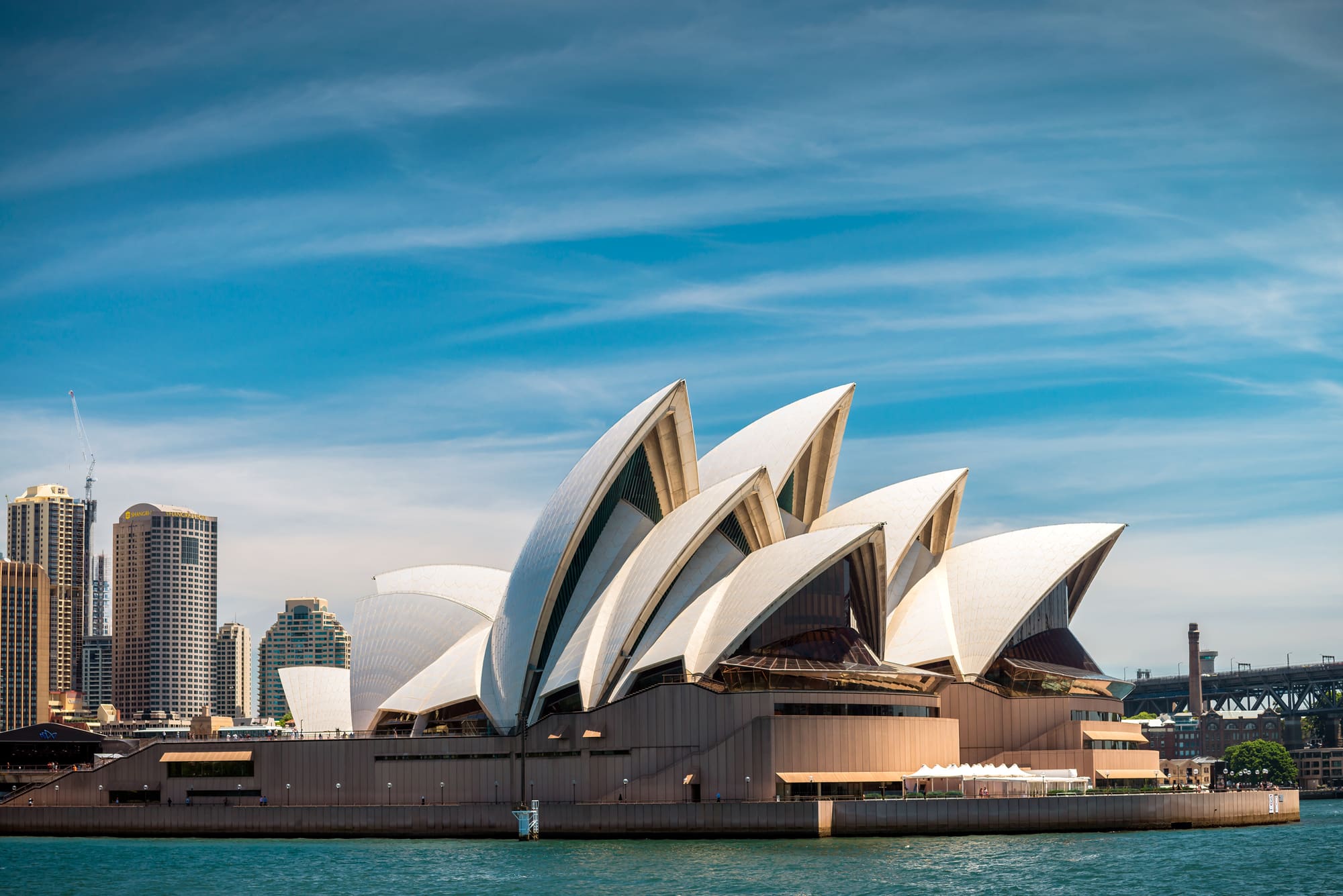
White-tiled shells cut from one sphere, on a harbour point the Gadigal call Tubowgule.
01
Introduction
A roof that looks improvised but was derived, shell by shell, from one geometric idea
The Sydney Opera House stands on Bennelong Point, a promontory that runs out into Sydney Harbour beside Circular Quay. Its roof of white-tiled concrete shells, which most people call sails, is among the most recognisable silhouettes in Australia. Beneath the shells sit several theatres and halls, a forecourt, a broad flight of steps and a lower concourse, all raised on a podium built into the point itself. The Danish architect Jørn Utzon designed it, and his competition entry, numbered 218, won in 1957.
It is not, strictly, an opera house in the way the name suggests. Opera was the first production in the hall now called the Joan Sutherland Theatre, while the largest hall, the Concert Hall, was redesigned during construction for symphonic music alone. What matters more to a visitor is how the roof was settled. After years of failed attempts, Utzon found that every shell could be derived from the surface of a single sphere, and the building's order follows from that. Sixteen years separate the competition from the opening, and Utzon left before the interiors were built.
Today the Opera House is a working venue, presenting about 1,850 performances a year. It is also Tubowgule to the Gadigal, a gathering place long before it had a roof, and a short projection on the eastern sails now tells First Nations stories each night.
02
History
From a shell-strewn point to a competition entry nobody quite expected to win
Before it was a building site, Bennelong Point was Tubowgule, the tip of a broad ridge, fringed by rocky shoals that the tide mostly covered. With water, a creek and mud flats on every side, food was plentiful: shellfish, fish, possums, wallabies and kangaroos. The Aboriginal people who lived and gathered here left shells and bones in heaps that archaeologists call middens. After 1788 the British penned cattle there and crushed the middens for lime, which is how the point came to be called Cattle Point and then Limeburners' Point. Governor Arthur Phillip had a brick hut built in 1790 for Woollarawarre Bennelong, a Wangal man, and the point took his name. Fort Macquarie went up under Francis Greenway in 1817 to 1821, and was demolished in 1902 for a tram shed.
The idea of a proper hall for music was pressed after the Second World War by the conductor Eugene Goossens, who found the Sydney Symphony Orchestra still playing in the 1889 Town Hall, and by Joseph Cahill, the NSW Premier from 1952. Cahill released an international competition in February 1956. Utzon, in his office at Hellebæk north of Copenhagen, sent off twelve drawings. His entry was one of the last of more than 220, and on 29 January 1957 the four assessors, among them the American architect Eero Saarinen, announced that it had won. Their report admitted that 'because of its very originality, it is clearly a controversial design'.
How the panel actually chose is not recorded. A widely repeated story has Saarinen arriving late, finding the scheme in a pile of rejects and declaring it the winner. One of the other judges, H. Ingram Ashworth, later denied it, saying that Dr Leslie Martin had liked the entry before Saarinen turned up. Either way, the estimate was 3.5 million pounds, and nobody had yet worked out how to build it.
Work began on 2 March 1959, in the rain, when Cahill screwed a bronze plaque into place where the axes of the two halls would cross. Cahill was in a hurry, afraid the project would be stopped, and the foundations began before the roof was designed. The ground turned out to be loose alluvial deposit soaked with seawater, not the sandstone that had been assumed, so about 700 steel-cased concrete shafts were bored down to carry the podium. Cahill died seven months later. The podium was finished in February 1963, two years late.
The roof took longer. Between 1958 and 1962 Utzon and the engineers at Arup tried parabolic, ellipsoid and finally spherical geometry. Utzon later said that the answer came one evening in his office as he stacked the models of the shells: they looked so alike that perhaps each could be taken from one sphere. He had realized that identical curves meant repeatable precast ribs and a uniform pattern of tiles, and in January 1962 he submitted the Yellow Book setting it out. The tiles, 120 millimetres square, were developed over three years by Höganäs of Sweden, and there are 1,056,006 of them on the roof.
By then the money had gone. The estimate stood at 13.7 million pounds by mid-1962, and after the government changed in 1965 the new Minister for Public Works, Davis Hughes, stopped paying Utzon for anything but drawings. On 28 February 1966 the two men met for about 15 minutes, Utzon walked out, and that evening Hughes told the press that he had resigned. A march of 1,000 people on State Parliament followed on 3 March, but it did not bring him back. A team led by Peter Hall was appointed on 19 April, and on 28 April Utzon flew out of Australia. He never returned.
Hall and his partners finished the interiors. The last of the 2,194 precast shell segments went up on 17 January 1967, the Concert Hall was redesigned for symphonic music only, and more than 6,200 square metres of French glass closed in the foyers. Queen Elizabeth II opened the building on 20 October 1973. Utzon later made his peace with the building from a distance: the Design Principles he agreed in 1999 and published in 2002 now guide changes to it, and in 2007 the Opera House was inscribed on the World Heritage List.
03
Timeline
Sixteen years from competition drawing to opening night, and a long afterlife of repair
Gadigal people gather shellfish and hold ceremony at Tubowgule, leaving shell middens
Governor Phillip builds a brick hut for Bennelong on the point
Fort Macquarie is completed on Bennelong Point
The fort is demolished and replaced by a tram shed
Jørn Utzon's design number 218 wins the international competition
Construction begins on 2 March, starting with the podium
Utzon's spherical geometry settles how the roof shells can be built
Utzon leaves the project and a team led by Peter Hall takes over
Queen Elizabeth II opens the finished building on 20 October
The Utzon Room reopens, redesigned by the architect
Inscribed on the World Heritage List on 28 June
The Concert Hall reopens after the Decade of Renewal works
The NSW Government announces A$120 million for maintenance and upgrades
04
Why visit
A building you can read like an argument between a poet, an engineer and a government
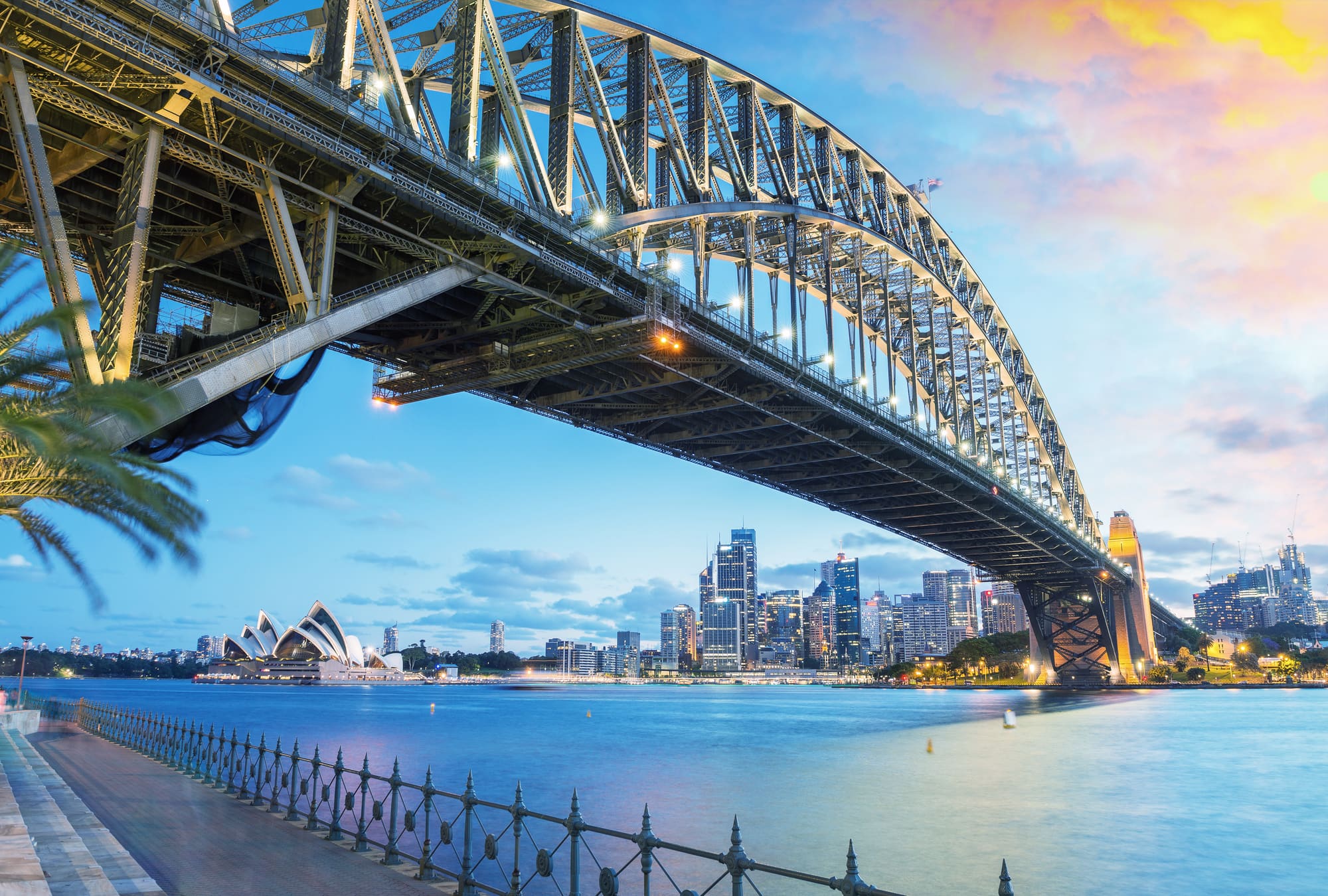
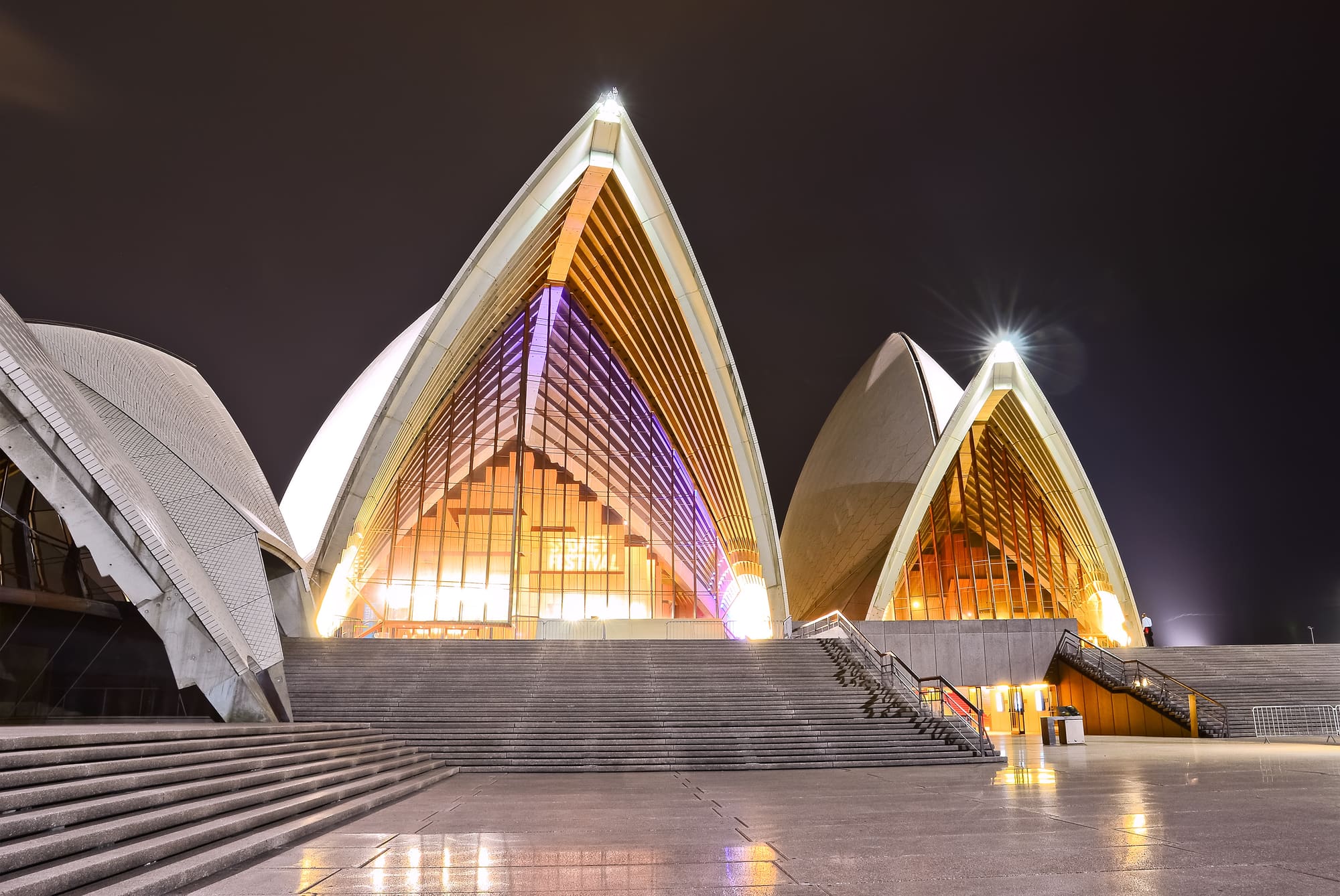
Most famous buildings are better in photographs. The Opera House holds up on the spot, because the harbour does half the work: white shells set against water, with the Harbour Bridge beyond, and a walk from Circular Quay that reveals new angles every few metres. The sails also double as a screen after dark, when a nightly projection of First Nations stories falls on the eastern shells.
It also explains itself, if you look. The great beams under the Monumental Steps, about 49 metres long, hold up the weight above without a single column. The shells are slices of one sphere, which is why they appear to belong together. The tiles were developed to be glossy without being mirror-like, so that the roof does not throw glare. A guided tour is worth taking for the detail alone, and because the route changes with whatever is rehearsing that day.
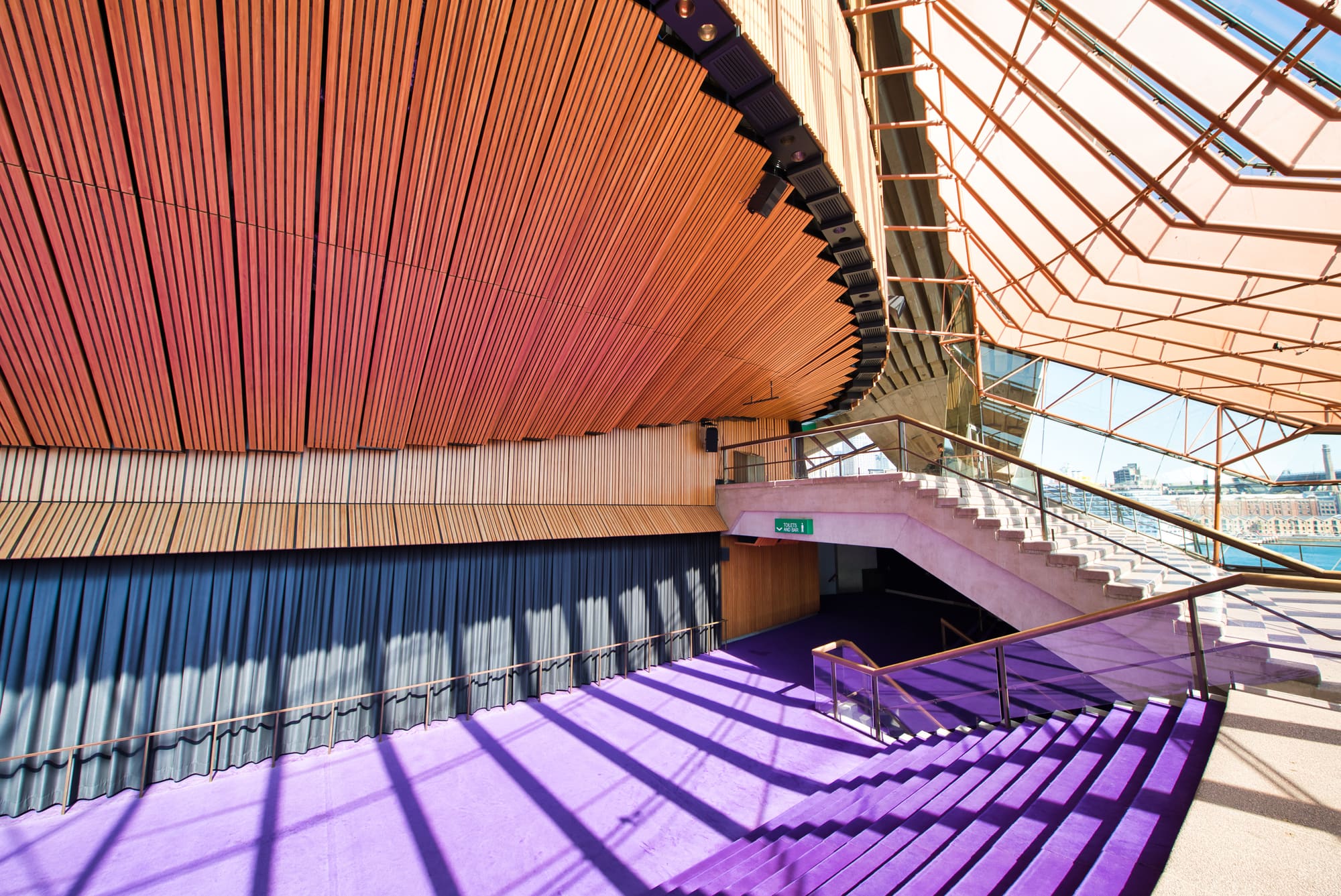
Then there is what the place says about people. Utzon, Ove Arup the engineer and Peter Hall each left a mark that can still be told apart, and the compromises between them are written into the stairs, glass walls and foyers. The foyers, with their curtains of glass, were meant to keep a visual relationship with the harbour, and they do. The Utzon Room, with its tapestry designed by the architect, is one of only two interior spaces finished entirely to his design. Elsewhere you are looking at the work of the architects who finished it after he left.
The building is used hard. It stages roughly 1,850 performances a year and receives nearly 11 million visitors, and its halls still serve the symphony orchestra, the opera and the theatre company alike. Underneath all of that is Tubowgule, a place of gathering for thousands of years, which the nightly Badu Gili projection brings back to the surface.
05
The setting
A small peninsula in the middle of Sydney, with the harbour on one side and a city on the other
Bennelong Point projects into Sydney Harbour beside Circular Quay, where trains, buses and ferries meet. The World Heritage property covers 5.8 hectares, about the size of a large park. A buffer zone, the protective margin around a property where development is controlled, is much larger at 438.1 hectares and extends over the surrounding waterscape. You can walk the whole outdoor precinct end to end in a few minutes.
The layout is simple once you have seen it. The Forecourt, the largest of the Opera House venues, holds up to 6,000 people standing. From it the Monumental Steps climb to the Podium, where the Concert Hall and the Joan Sutherland Theatre sit side by side beneath the main shells. Beneath the steps is the lower concourse, with the Welcome Centre and the single entry point to the venues. A car park lies beneath the building.
Sydney has a mild, humid climate. At the Bureau of Meteorology's Observatory Hill station, the mean daily maximum is 26.0°C in January and 16.4°C in July, while the mean minimum drops to 8.1°C in July. Rain averages about 1,213 millimetres a year, and falls most heavily from March to June, with September the driest month at 68 millimetres.
Nearby are the Royal Botanic Garden and The Domain, and the old streets of The Rocks. The eastern Bennelong sails, which take the Badu Gili projection, are best watched from the Podium level.
06
Key places
Seven spaces, from the outdoor steps to the one room that Utzon finished himself
The Forecourt and Monumental Steps
The approach is the largest room in the complex. The Forecourt can hold 6,000 people standing for concerts, and above it the Monumental Steps climb to the Podium level under the sails. A bronze plaque that Utzon brought from Denmark, and that Premier Cahill screwed into place on 2 March 1959, can still be seen on the steps. The Badu Gili projection is best viewed from the upper level. Allow ten minutes to take it in, and longer if a concert is being set up.
The lower concourse and the concourse beams
Beneath the steps, the concourse is where the building keeps its working life: the Welcome Centre, the shop and the single entry point to the venues. Look up at the undulating concrete beams, about 49 metres long, which replaced the colonnade Utzon had sketched. Ove Arup proposed them, and Utzon came to call them 'Ove's invention'. The tile factory for the roof was set up here as well. Stand under the middle of them for a moment, because the span is easier to judge from below than from any photograph.
The Concert Hall
The largest hall seats up to 2,102 facing the stage, and 2,664 in the round. It was redesigned during construction for symphonic music alone, which is why the Sydney Symphony Orchestra plays here rather than in a dual-purpose hall. The Northern Foyer holds John Olsen's mural Salute to Five Bells, unveiled in 1973 and inspired by Kenneth Slessor's 1939 poem. The hall was closed in February 2020 and reopened in July 2022 after renewal works. You will see it mainly on a tour or with a ticket.
The Joan Sutherland Theatre
Seating up to 1,507, this was the Opera Theatre until 2012, when it was renamed for the soprano who sang here from 1974 until her farewell on 2 October 1990. Its Northern Foyer holds Possum Dreaming, a mural by the Warlpiri artist Michael Nelson Jagamara, unveiled in 1988 to replace a photographic mural that had hung there since opening. It is about ten metres long and under two metres high. Foyers like this one are open before performances, so a ticket is the easiest way in.
The sails and their tiles
The roof is made of precast concrete ribs covered in 1,056,006 tiles, laid in 4,228 chevron-shaped panels that were cast face down. The tile itself, the Sydney Tile, is 120 millimetres square and was developed by Höganäs of Sweden from clay with a little crushed stone, to give a gloss that does not glare. Utzon wanted it to contrast with the blue of the harbour and the sky. The best way to appreciate the colour is simply to look across the water at different times of day.
The Utzon Room
Formerly the Reception Hall, this room was redesigned by Utzon and reopened in September 2004 under his name. It is one of only two interior spaces finished entirely to his design and specifications. A 14-metre woollen tapestry, his first decorative artwork, hangs along one wall, and floor-to-ceiling windows face east across the harbour. It holds up to 200 people. Entry is through the same single point under the Monumental Steps as the other venues.
The Colonnade and western foyers
The Colonnade, completed in 2006, was the first change to the exterior and the last project Utzon led. It shades nine large glass openings along the western side that give the theatre foyers their first view of the harbour, modelled on windows at Can Lis, the house he built in Majorca. His son Jan and the Sydney architect Richard Johnson worked with him. From inside, the effect is that the foyer becomes a harbour-side room.
07
What to expect
Stairs inside, crowds outside, and a route that depends on who is rehearsing
You can admire the sails from a bench. The interior has to be earned. The standard one-hour tour covers up to 2.5 kilometres and about 300 stairs, with no lift or escalator and little chance to sit. It moves at a steady pace, groups are capped at 35 people, and guides use headsets, so people with sensitive hearing are advised to write to the tours team first. Expect to be on your feet for the whole hour.
The outdoor precinct is crowded for much of the day, since the Opera House says it receives more than 10,000 visitors daily. Security screening is a condition of entry to the venues, and the Opera House suggests arriving at least 20 minutes before a performance to allow for it. Anything larger than an A4 sheet of paper must be cloaked. For a tour, arrive at the Welcome Centre 15 minutes early: a traveller who turns up more than five minutes after the start forfeits the tour, with no refund.
The interior is not what the exterior suggests. You move through a working theatre, so the route differs from day to day depending on which halls are free. One day that might mean the Concert Hall, another a corridor behind a stage. And the foyers, with their long glass walls, feel more like rooms open to the harbour than parts of a theatre.
The Architectural Tour on Saturday mornings also involves over 300 stairs, and flat, comfortable shoes are recommended for it. The Mobility Access Tour uses lifts and escalators with a smaller group, and the Opera House advises that a single stick or crutch may be allowed on the standard tour at the team's discretion. Everything you need to eat or drink is on the premises, from the restaurants on the promenade to the bars in the foyers. The sails are best seen from a distance, the details from beneath. Worth the effort, on balance.
08
Photographs
More of the place, as it looks on the ground
09
Planning your visit
Book the tour ahead, then come back after dark for the sails
Best months
- January
- February
- March
- April: best
- May
- June
- July
- August
- September: best
- October: best
- November: best
- December
April and September to November
- Time needed
- Half a day
- Crowding at peak
- Busy
- Access
- Interior visits need a guided tour or a performance ticket. Arrive 15 minutes before a tour; it is forfeited after five minutes late. Venue entry involves bag screening, and bags larger than A4 are cloaked. Tours do not run on 25 or 31 December 2026.
- Accessibility
- The Opera House aims for barrier-free access and publishes accessible routes, maps and videos. The standard tour has about 300 stairs and no lift, so it is not suitable for wheelchairs or walkers. A stair-free Mobility Access Tour runs daily at 11:30am and 2:45pm, and a free wheelchair-accessible courtesy bus connects Circular Quay for performances. The Forecourt is wheelchair accessible. Assistance animals are welcome.
- Entry
- Standard guided tour: 50 Australian dollars (AUD) for an adult booked in advance, 55 on the day; 52 and 57 from 1 April 2027
- Services
- Good servicesToilets and some food and drink on site; accommodation nearby
Practical details checked on
Most visitors need about half a day: an hour for the tour, time on the steps and the Forecourt, and a meal or a drink with a view. A performance in the evening adds the rest. Buying a tour ticket in advance is cheaper than on the day, and the Opera House encourages it.
The tours are the structured way to see the interior; a ticket to a performance is the other way in. The standard tour runs daily, the Mobility Access Tour at 11:30am and 2:45pm, and the Architectural Tour on Saturday mornings and some Sundays. Several languages are offered for the standard tour. Tours do not run on 25 and 31 December 2026.
The climate figures point to September to November, when Sydney is mild and relatively dry, or to April for mild temperatures; January is the hottest month and July the coolest. The Badu Gili projection runs nightly at sunset in several sessions, with times that change with each edition, so check the Opera House before you go.
Base yourself in the city centre or The Rocks, both close to Circular Quay. Bookings for more than 15 people are made by telephone through the Opera House's tours team, and accessible seating through the Box Office. Arrive for a tour at the Welcome Centre or, for the Mobility Access Tour and the Backstage Tour, at the Stage Door under the Monumental Steps.
On-site services
A Welcome Centre on the lower concourse handles tour check-in and information, next to the Opera House shop. Bennelong, Midden, Opera Bar and Winnie's serve food and drink, and bars in the Concert Hall and Joan Sutherland Theatre foyers open before shows. A cloakroom takes larger bags from ticket holders, bicycles can be left beneath the Monumental Steps, and a free courtesy bus and accessible buggy run from Circular Quay.
10
Getting here
Thirteen minutes by train from the airport, then a short walk from Circular Quay
Sydney Airport is 8 kilometres from the city centre. Trains from the airport stations to the city take about 13 minutes, according to the airport, and run roughly every 10 minutes between 5am and midnight. The fare is made of two parts: the normal Opal fare plus a station access fee, which stood at 18.61 Australian dollars (AUD) for an adult in October 2026. A flat taxi fare of A$60 for the airport to the CBD has been on trial since 3 November 2025.
From the city, you reach Circular Quay by train, bus or ferry, then walk. The Opera House gives the walk as six minutes, though its tour pages say seven to ten. Public transport enquiries can be made on 131 500, or through Transport Info. You can tap on and off with a contactless card, linked device or an Opal card.
Driving is possible, but there is little reason to do it. The Opera House car park, run by Wilson Parking, has 1,200 bays, is open 24 hours, and is entered from 2 Macquarie Street. The entry height is 2.2 metres. Taxis and private cars are directed to the rank on Macquarie Street, past the car park entrance, since almost all vehicle movements have been removed from the Forecourt.
On arrival, a free courtesy bus and accessible buggy service runs between Circular Quay and the Opera House doors for matinee and evening performances. Bicycles, scooters and skateboards must be dismounted at the site boundary and walked, carried or parked; bike parking is beneath the Monumental Steps.
Visa rules depend on your nationality and change from time to time. Check the Australian Government's Department of Home Affairs before you book; this guide does not summarise them. The Welcome Centre, where tours check in, is open from 8:45am to 5pm daily and closed on Christmas Day and New Year's Eve.
Before you set out, look at the Opera House's own Getting here pages for the current state of the courtesy bus, the car park and any works around the precinct. Both airport rail and ferry services are run by others and can be affected by weekend track work or weather, and the 131 500 line is the quickest way to check.
11
Local culture
A place the Gadigal call Tubowgule, still used for ceremony, music and storytelling
The Opera House stands on Gadigal Country. The Gadigal name for the point, Tubowgule, is rendered by the Opera House as 'where the knowledge waters meet', and the site has been a place for gathering, ceremony and storytelling for thousands of years. The Opera House describes the cultural traditions of the Gadigal and the connection to Country as part of its heritage significance, and publishes a Reconciliation Action Plan.
The link was acknowledged at the opening itself. In 1973 Ben Blakeney, a direct descendant of Bennelong, appeared silhouetted at the apex of one of the sails to welcome the public. In 1985 the Opera House presented Music and Dance of the First Australians, its first major programme of First Nations work, and in 2000 an Olympic Arts Festival opened with Tubowgule, a piece of dance and music evoking the ceremonies held on the point for thousands of years.
That programme continues. Badu Gili, which means water light in the Gadigal language, is a free six-minute projection on the eastern sails shown nightly, with a new edition each season featuring First Nations artists such as the Gooniyandi man Mervyn Street and the Inuk storyteller Ningiukulu Teevee. DanceRites, a biennial celebration of First Nations dance, song and culture, takes place on the Forecourt, and the October 2026 edition is to feature more than 300 dancers. Music on Tubowgule, which began in 2025, showcases new First Nations musical work.
Aboriginal artworks are part of the interior too, including Possum Dreaming by the Warlpiri artist Michael Nelson Jagamara in the Joan Sutherland Theatre foyer. Food has joined the picture, with Midden by Mark Olive serving contemporary Australian dishes with native ingredients, and a menu at the Box Office Lounge that draws on Bundjalung food knowledge.
12
Anecdotes
Stories from the design table, the scaffolding and the stage
The most repeated story about the design is probably not quite true. It says Eero Saarinen rescued Utzon's entry from the rejected pile; one of the judges denied it. A second says that Utzon had his idea for the roof while peeling an orange. The Opera House says the orange can indeed demonstrate the sphere, but that it was Saarinen who used a grapefruit and then an orange, years before, to explain the thin shells of his own airport terminal in New York.
The first performance came long before the building was finished. In 1960, before a single shell had gone up, the American singer and civil rights activist Paul Robeson climbed the scaffolding and sang Ol' Man River to the construction workers. The official opening night in the Opera Hall was not until 28 September 1973, with Prokofiev's War and Peace.
Inside the Concert Hall foyer hangs John Olsen's mural, named after Kenneth Slessor's 1939 poem Five Bells. According to the Opera House, the poem was prompted by the death of the cartoonist Joe Lynch, who fell off a ferry near what is now the Opera House, weighed down by bottles of beer in his overcoat pockets. Slessor's elegy ends with a meditation on the harbour at night. Sydney, then, has put a drowned cartoonist at the centre of its most celebrated poem, and a vast painting about it in its most celebrated building.
In 1990, Nelson Mandela, recently freed after 27 years in prison, spoke of forgiveness from the Monumental Steps. That year the director Baz Luhrmann staged Puccini's La Bohème in the Opera Theatre, set in 1950s Paris. Seven years later he married the production's designer on the same stage, in front of the same set.
13
Local cuisine
Oysters were here first, and native ingredients have followed them onto the menus
Oysters were arguably the Opera House's first residents. The middens of Tubowgule were built from them, along with mussels and fish bones, before the British crushed the shells for lime. Eating an oyster on the point is therefore closer to tradition than novelty.
The food on site now draws on that history. Midden, run by the chef Mark Olive, serves contemporary Australian cooking with native ingredients and Indigenous storytelling. At the Box Office Lounge, the all-day menu was created with the Bundjalung chef Mindy Woods and features saltbush, finger lime and native dukkah, a spiced blend of nuts and seeds. Bennelong is the fine-dining room, and Winnie's offers seafood-driven share plates on the lower concourse, with sunset drinks on the water.
The theatre bars list only Australian wines, so a glass before the curtain keeps you within the country. Beyond the building, The Rocks has pubs that opened in the 1820s and 1830s, if you would rather drink in a colonial setting.
14
Events and festivals
Light, dance and a midsummer countdown, all played out beside the water
Nightly, from sunset
Badu Gili
A free six-minute projection of First Nations stories on the eastern Bennelong sails. The artists and the number of sessions change with each edition, so check the Opera House for the current schedule.
Late May to June
Vivid Sydney
A citywide festival of light, music, ideas and food. The Opera House takes part with Lighting of the Sails, a new artwork projected onto the sails. The 2027 festival runs 28 May to 19 June.
October, in alternate years
DanceRites
A biennial celebration of First Nations dance, song and culture on the Forecourt, with competition and special guest performances. The 2026 edition runs on Saturday 24 and Sunday 25 October.
31 December
New Year's Eve on the Forecourt
The Opera House lists its own New Year's Eve event on the Forecourt, which stages concerts for up to 6,000 people standing. Check the Opera House for access and ticketing before planning to attend.
15
Challenges
Salt water, ageing machinery and the pressure of being the country's most photographed building
The Sydney Opera House is not on the List of World Heritage in Danger, and in 2007 the World Heritage Committee described its state of conservation as very good. No later Committee review of the site turned up while preparing this guide. The pressures on it are those of a heavily used building that stands in salt water, and its managers describe them as a matter of constant care and maintenance. The Opera House follows a Conservation Management Plan, the Utzon Design Principles and a Heritage Action Plan, and in August 2026 the NSW Government announced A$120 million for further maintenance and upgrades.
- Structure beneath the Northern Boardwalk has been exposed to the harbour's marine environment for more than 50 years. The NSW Government's A$120 million programme includes strengthening it, so that major public events can continue there.
- Theatre machinery in the Western Venues, the Playhouse, the Drama Theatre and the Studio, is up to 50 years old. The same programme will replace it and improve safety and accessibility.
- Visitor numbers are high, at nearly 11 million a year. In 2007 the Committee asked the Australian authorities to reconcile growing visitor numbers with the working of the performing arts centre and the preservation of the property's values.
- The Committee also recommended construction rules for the buffer zone to protect the skyline of the harbour shore, and asked that the interiors and the different stages of construction be conserved alongside the exterior.
- Requests to use the sails for lighting and promotion have caused public disputes. In 2018 a proposal to project a racing logo drew a petition of 311,000 signatures, and a compromise was reached.
16
Travelling responsibly
A few rules for a very busy precinct that is also someone's country
- Dismount bicycles, scooters and skateboards at the site boundary. The precinct receives more than 10,000 visitors a day, and compliance is mandatory under the Trust's by-law.
- Leave drones at home. They are on the Opera House's prohibited list, along with professional cameras and glass beverage containers at venue entries.
- Travel light. Bags larger than A4 are cloaked at venues, and screening is a condition of entry, so a small bag saves everyone time.
- Arrive early for tours and keep your voice down inside: a rehearsal or performance may be under way in the next hall.
- Treat Badu Gili as a cultural event rather than a photographic backdrop, and watch from the Podium level, which the Opera House gives as the best viewpoint.
- Walk or use public transport from Circular Quay. Almost all vehicle movements have been removed from the Forecourt, which is now a space for pedestrians and events.
- Remember that Tubowgule is Gadigal Country, and take a moment to learn that history before photographing the building.
17
In the news
Recent reporting, summarised
· ABC News
Curtain closes on Louise Herron's 14-year leadership of the Sydney Opera HouseThe outgoing chief executive looks back on the 2018 dispute over projecting onto the sails, the Concert Hall renewal and a A$120 million package for smaller theatres and marine footings.
· NSW Government
Securing the future of live performance at the Sydney Opera HouseA$120 million will replace ageing theatre machinery in the Western Venues and strengthen the structure under the Northern Boardwalk after more than 50 years in salt water.
18
Frequently asked questions
The questions travellers ask most
How long does a visit take?
Half a day covers the guided tour, a wander round the precinct and a meal. The standard tour lasts about an hour and the Architectural Tour about 75 minutes. Add the evening if you want to see a performance or the sails lit.
Can you go inside without seeing a show?
Yes, on a guided tour. The Opera House encourages booking in advance. Tours depart from the Welcome Centre or the Stage Door, depending on the tour, and the route varies with the day's performances.
Is the Opera House suitable for wheelchair users?
The standard tour is not, because it involves about 300 stairs and no lift. The Mobility Access Tour is step-free and runs daily. The Forecourt is wheelchair accessible, and the Opera House publishes access maps and videos for the precinct.
Can I fly a drone?
Drones are on the Opera House's prohibited items list at venue entries. Other rules may apply across the harbour, so check with the relevant Australian authorities before flying anywhere in Sydney.
Did Utzon ever see the finished building?
No. He left Australia on 28 April 1966, seven years before the opening, and never returned. He later agreed to set out principles for future changes, and he received the Pritzker Prize in 2003.
When can I see the sails lit up?
The Badu Gili projection runs nightly at sunset, with several sessions on the evening, and is free. Times and artists change with each edition, so check the Opera House before you go.
19
Location
Circular Quay on one side, the Botanic Garden on the other, and the old city behind
Bennelong Point sits beside Circular Quay, where Sydney's trains, buses and ferries meet. Everything in this area is within walking distance, and the Opera House gives six minutes as the walk from the quay. The city centre is a short walk from the quay too, and the harbour opens out beyond the point in every other direction.
To the west, across Circular Quay, lies The Rocks, the first area settled in Sydney, with its sandstone lanes, weekend markets and the Museum of Contemporary Art Australia. The Sydney Harbour Bridge, which has a Pylon Lookout, belongs to the same district. The Royal Botanic Garden, with The Domain wrapped around it, runs along the harbour nearby and gives the point a green neighbour.
Sydney Airport is about 8 kilometres from the city centre, and the rest of the harbour is reached by ferry from the quay. Within the precinct itself, the Forecourt, the Monumental Steps and the Podium are on the outside, while the lower concourse, Welcome Centre and car park sit beneath them.
Sydney Opera House is about 8 km north-east of Sydney. The nearest other World Heritage site is Australian Convict Sites, about 55 km away.
Nearest towns and cities
- Sydney · about 4,630,000 peopleabout 8 km south-west
- Wollongong · about 261,000 peopleabout 70 km south-west
- Katoomba · about 22,000 peopleabout 85 km west
- Newcastle · about 541,000 peopleabout 130 km north-east
- Nowra · about 95,000 peopleabout 130 km south-west
- Goulburn · about 21,000 peopleabout 170 km south-west
20
Around the site
Places worth the detour, and the nearest World Heritage neighbours
Royal Botanic Garden Sydney
Described by its managers as Australia's oldest botanic garden, the Royal Botanic Garden Sydney stands on Gadigal Country and overlooks the harbour, with The Domain wrapped around it. It makes a green counterweight to the crowds on the Opera House steps, and sits close enough to visit on foot.
The Rocks
The first area of Sydney settled by Europeans, in 1788, now a quarter of sandstone lanes, weekend markets with more than 200 stalls and pubs dating from the 1820s and 1830s. The Rocks Discovery Museum, in an 1850s warehouse, covers the area from before European settlement to the present.
Museum of Contemporary Art Australia
A gallery in The Rocks, on the western side of Circular Quay, showing photography, sculpture, painting and moving image by Australian artists at all stages of their careers. Its café on level four, popular for its views across the quay, makes a natural stop after the tour.
Sydney Harbour Bridge Pylon Lookout
One of the standard ways to see the Opera House from above is the Pylon Lookout on the bridge, which offers views over the harbour and the city. It belongs to the same district as The Rocks, close to the quay.
Nearby World Heritage sites
AustraliaCultural57 km away
AustraliaNatural114 km away
AustraliaNatural497 km away
21
Further resources
Books, links and people who know the ground
Books
- The Saga of the Sydney Opera House: The Dramatic Story of the Design and Construction of the Icon of Modern AustraliaPeter Murray, 2004
- Building a Masterpiece: The Sydney Opera HouseAnne Watson (editor), 2006
Links
The official record
- World Heritage Centre page for this sitewhc.unesco.org
- Australian Government Department of Home Affairs: visitor visasimmi.homeaffairs.gov.au
Trip reports
No one has written up a visit to Sydney Opera House yet. If you have been, we would like to hear how it went.
Been here? Share a trip reportGuest reports are credited and edited with you before they appear.
Suggest a correction or additionEvery message is read by an editor.
Last reviewed